



Custom bakery packaging for bread and pastry
Bakery packaging is the bag or film that controls how fast a baked product loses or takes up moisture. Fresh crusted bread has to release water vapour, so the pack is micro-perforated; butter pastry has to be held away from its own fat, so the sealing layer is specified for grease; chilled and frozen products have to stay visible and stay sealed at temperatures where ordinary film fails. That single decision, breathe or seal, sets everything else.
VLM Poliplast manufactures custom bakery packaging in Bucharest for Romania, Moldova and the EU: micro-perforated bread bags, flow wrap film for pastry lines, anti-fog film for chilled display, structures for frozen bake-off, and single-family alternatives for producers moving off mixed laminates. Bags and reel-fed film, printed 1–8 colours to your artwork or unprinted for self-adhesive labels, private label on request.
Reels run in widths from 100 to 1300 mm for automatic VFFS and HFFS lines. Ready-made bags cover manual and semi-automatic packing, closed with clip band or tape. Bakery packaging is one of the sectors covered on the industries page.
ISO 9001, ISO 22000, ISO 14001 and ISO 45001 · Migration testing at an independent third-party laboratory · No intentionally added PFAS, in line with Article 5 of Regulation (EU) 2025/40 · Printed 1–8 colours · Reels 100 to 1300 mm · EU manufacturer
When bakery packaging has to breathe, and when it has to seal
Breathe: perforated structures
Crusted bread sold the same day or the next · Baguettes, rye and sourdough loaves, rolls and buns · Products still releasing vapour when they are packed · Anything where a soft crust is a complaint · Products where visible condensation on the film would stop the sale
Seal: closed structures
Sliced packaged bread with an extended shelf life, where softness is the selling point · Butter pastry, where fat migration is the failure mode · Dry and fragile products, biscuits, breadsticks, rusks · Frozen dough and par-baked goods · Chilled products, where the pack seals but needs an anti-fog inner layer
What goes wrong when the structure is not right
In bakery, a wrong structure shows up within days and it costs shelf space.
| Situation | Consequence | What it takes |
| Sealed film on fresh crusted bread | Condensation inside the bag, soft crust, mould within days, returns from retail | Micro-perforated BOPP, hole density matched to the product |
| Standard sealing layer on butter pastry | Fat migrates into the film, stains the print and weakens the seal | BOPP/CPP with a sealing layer specified for fat contact |
| No anti-fog on chilled products | Droplets on the film hide the product in the cabinet | Anti-fog treatment on the inner layer, validated in real cabinet conditions |
| Ordinary film on frozen bake-off | Film turns brittle, seals open under the weight of rigid product, freezer burn | PET/LDPE laminate sized for the fill weight and the pallet |
Formats we make for bakery and pastry
The packing line decides the delivery format, and the product decides the structure. The two are chosen in the same conversation.
| Format | What it suits | Functional features | Usual structure |
| Micro-perforated bread bag, three-side seal | Artisan and retail crusted bread | Perforation matched to the loaf, clear window, clip band or tape closure | Micro-perforated BOPP, around 30 microns |
| Plain and perforated bread bag | Rolls, buns, pre-packed sliced bread | Printed or plain, micro or macro perforation, clip or tape | LDPE film or micro-perforated BOPP, 25–40 microns |
| Flow wrap pillow bag (HFFS) | Croissants, brioche, individually wrapped pastry | Back or centre seal, grease resistant sealing layer, anti-fog on request | BOPP or BOPP/CPP, 30–50 microns |
| Stand-up pouch with press-to-close zip | Breadsticks, biscuits, rusks, dry fragile products | Zip closure, easy open, eurohole, clear window | BOPP/CPP or polyester laminate |
| Three-side seal | Portioned snacks, biscuits, single pastries | Easy open, eurohole, printed or clear | BOPP/CPP or polyester laminate |
| Rollstock film (VFFS, HFFS) | Automatic lines, high volume | 30–70 microns, widths 100 to 1300 mm, perforated or anti-fog on request | BOPP, BOPP/CPP or laminate |
| Frozen and bake-off bag | Frozen dough, par-baked goods for in-store bakeries and HoReCa | Cold flexibility, seal strength under load, printed or plain | PET/LDPE laminate, or heavier LDPE film sized for the load |
Structures: what each one does
Bakery reverses the usual barrier logic. Most food films are designed to keep everything out; a bread bag often has to let water vapour out at a defined rate. The structure is what sets that rate, and what decides how the pack is treated at end of life.
| Structure family | Moisture behaviour | Grease resistance | End of life | Bakery applications |
| Micro-perforated BOPP | Controlled vapour release through the perforation pattern | Moderate | Single polypropylene family, sortable in the PP film stream | Crusted bread, baguettes, artisan retail |
| Micro-perforated Mono-PE | Controlled vapour release | Moderate | Single polyethylene family, sortable in the PE film stream | Breathable packs for producers targeting the PE stream |
| BOPP/CPP | Closed, holds moisture in | High, with a sealing layer specified for fat | Single polypropylene family, sortable in the PP film stream | Flow-wrapped pastry, biscuits, breadsticks |
| Film with anti-fog treatment | Closed, condensate spreads instead of beading | Specified with the structure | Follows the base structure it is applied to | Chilled display: sandwiches, cream products, chilled pastry |
| PET/LDPE laminate | High moisture barrier, stays flexible at freezer temperature | Good | Mixed structure, no single dedicated stream | Frozen dough, par-baked goods, bake-off |
| LDPE film, plain or perforated | From closed to freely breathing, depending on perforation | Low | Single polyethylene family, sortable in the PE film stream | Rolls, buns, secondary and transport packs |
Barrier and permeability are described qualitatively here and documented per structure on its technical data sheet, from laboratory test methods, not quoted as headline numbers. Shelf life is set by the bakery, from testing on the finished product. VLM Poliplast does not issue a certified RecyClass class and does not certify that a finished pack meets PPWR requirements: single-family structures are designed against RecyClass design-for-recycling criteria, and recyclability is assessed on the complete pack.
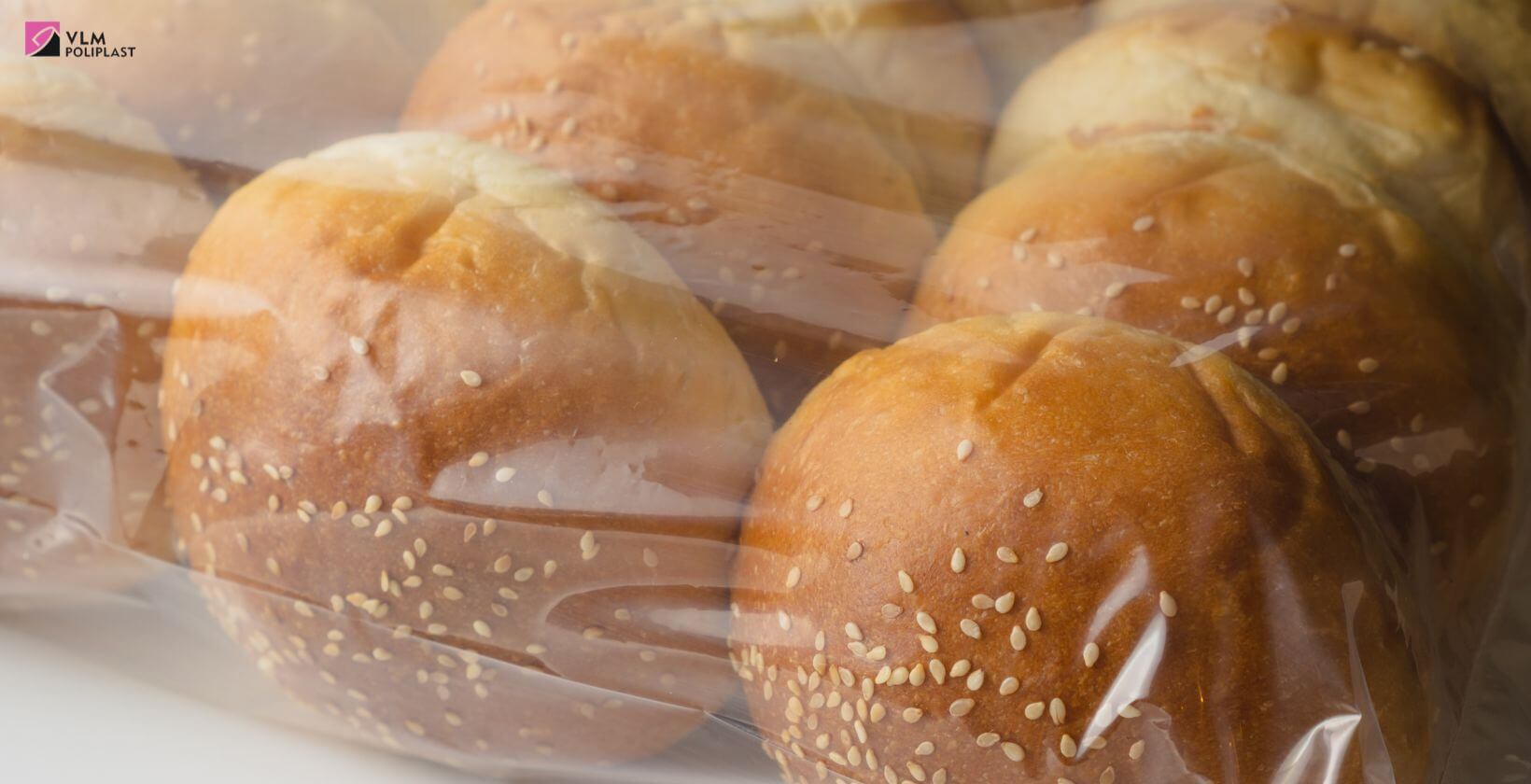
Micro-perforated bread bags: why bread packaging has to breathe
The oldest question in bread retail is paper or plastic. Paper breathes, so the crust stays crisp, but the loaf is invisible and the bag tears when it gets greasy or wet. Plastic shows the product and protects it, but a sealed film traps vapour: the crust softens first, then condensation starts the mould cycle. The answer is not one material or the other, it is a defined water vapour permeability.
Micro-perforated BOPP carries a pattern of holes small enough to keep dust and handling contact out, dense enough to evacuate vapour at the rate the bread releases it. Hole diameter and density are selected per product: a dense rye loaf, a baguette and packaged sliced bread each release moisture differently.
For artisan retail, three-side seal bags in micro-perforated BOPP with a clear window, around 30 microns, keep the crust and leave the loaf visible. For pre-packed industrial bread, LDPE film or micro-perforated BOPP at 25 to 40 microns runs on automatic lines. Sliced packaged bread with an extended shelf life sits at the other end of the scale: less crust to preserve, more softness to keep, so permeability is reduced and the closure, clip band or tape, does the rest.
Flow wrap film for croissants and packaged pastry
Individually wrapped croissants, brioche and pastry run on horizontal flow wrap lines fed from reels. The usual films are BOPP and BOPP/CPP of 30 to 50 microns, in widths matched to the product, within the 100 to 1300 mm range supplied for automatic lines.
Two properties decide the film: seal stability at your line speed, and a sealing layer specified for fat contact, because butter migration is the typical failure mode of pastry packaging. BOPP/CPP keeps both layers in the polypropylene family, which gives pastry producers a single-family route without changing the packing line.

Anti-fog film for chilled bakery display
Sandwiches, cream products and chilled pastry meet a display problem rather than a shelf life problem: vapour inside the pack condenses on the cold film as droplets, and a product the shopper cannot see does not sell. Anti-fog treatment lowers the surface tension of the inner layer, so condensate spreads into a uniform transparent sheet. Anti-fog variants are available for flow wrap film and for bags intended for chilled display; the treatment is specified when the structure is defined, and validated on your product in real cabinet conditions.
Frozen bakery and bake-off packaging
The bake-off segment, frozen dough and par-baked goods supplied to in-store bakeries and HoReCa, asks the opposite of breathability: containment and cold performance. Ordinary films turn brittle at -18 °C, seals crack under the weight of rigid frozen product, and uncontrolled vapour transfer causes freezer burn. Suitable structures are PET/LDPE laminates, or heavier LDPE film sized for the load, designed around seal strength under load and impact resistance at freezing temperatures. The structure is sized on the fill weight, the palletising pattern and the logistics chain, from blast freezing to the retail cabinet, and validated on your product before the series order.
Single-family bakery packaging: EcoMonoFilm®
Mono-PE and BOPP/CPP structures stay inside a single polymer family, which makes them sortable in the matching PE or PP film stream, and they are designed against the RecyClass design-for-recycling guidelines, a voluntary industry methodology. For bakery this includes micro-perforated Mono-PE, so moving away from mixed laminates does not cost you crust preservation. EcoMonoFilm® is the polyethylene range for exactly this case. Producers planning the change can start from the EU packaging regulation overview and the PPWR declaration of conformity.
Bakery packing lines and matching formats
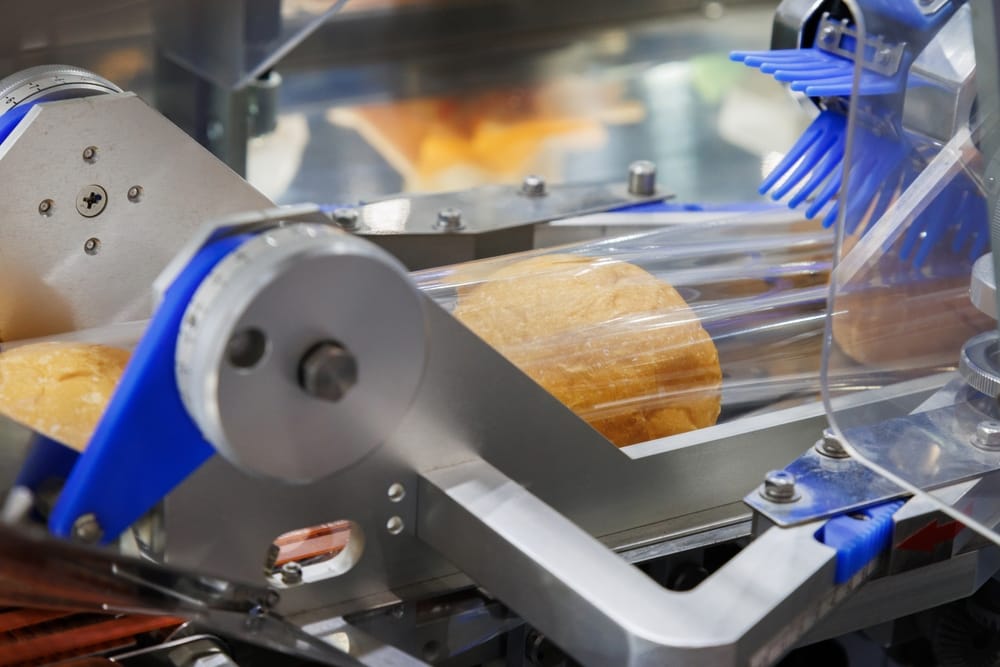
Manual and semi-automatic packing uses ready-made bags: micro-perforated BOPP bags with or without a window, and stand-up pouches with a press-to-close zip for breadsticks and biscuits. Closures on manual lines are clip band or tape. Automatic VFFS and HFFS lines take film on reels, 30 to 70 microns, widths 100 to 1300 mm, forming the pack in line with filling.
Reel-fed film is calibrated to your line: sealing bar temperature, coefficient of friction and unwind tension. Send those parameters with the specification and they go into the technical data sheet delivered with the order.
Compliance for bakery and pastry packaging
All food-contact structures comply with Regulation (EC) No 1935/2004 and Regulation (EU) No 10/2011, as amended by Regulation (EU) 2025/351, with a declaration of conformity issued per structure. Migration testing is carried out at an independent third-party laboratory.
Regulation (EU) 2025/40, the PPWR, applies to all packaging placed on the EU market, not only food packaging. Its design-for-recycling requirement applies from 1 January 2030, or 24 months after the delegated acts under Article 6(4) enter into force, whichever is later. The restriction on intentionally added PFAS in food-contact packaging, Article 5, applies from 12 August 2026.
VLM Poliplast operates management systems certified to ISO 9001:2015, ISO 14001:2015, ISO 22000:2018 and ISO 45001:2018. Barrier and permeability figures quoted in specifications come from laboratory test methods, which are a separate matter from those management systems.
Choosing the structure, step by step
- The product and its moisture behaviour. Crusted bread that has to breathe, soft packaged bread, fatty pastry, dry fragile products or frozen goods. This sets the direction between perforation, grease resistance, moisture barrier or a freezer structure.
- Shelf life target and display conditions. Same-day sale, extended shelf life for sliced bread, a chilled cabinet with an anti-fog requirement, or a frozen chain.
- Packing line. Manual with clip or tape closure, flow wrap on HFFS, ready-made bags, or reel-fed film for VFFS in widths of 100 to 1300 mm.
- Format and dimensions. Plain or perforated bag, flow wrap, stand-up pouch with or without a zip, or three-side seal, sized on the product.
- Print and shelf identity. Printed 1 to 8 colours to your artwork, or unprinted for self-adhesive labels.
- Design for recycling. A single-family structure where the application allows it, so the pack is ready for the criteria the Commission sets by delegated act.
What you send, what you get back
What you send
Product: crusted bread, sliced bread, pastry, biscuits, chilled or frozen goods · Unit weight and estimated monthly volume · Shelf life target and storage conditions · Packing line: HFFS, VFFS, semi-automatic or manual, with reel width if known · Features: window, zip closure, easy open, eurohole · Print: number of colours, or unprinted · Whether a single-family structure is a requirement
What you get back
A format and structure proposal for your product · Full specifications: dimensions, thickness, perforation, sealing parameters · How the structure is treated at end of life, stated plainly · Food-contact documentation for the structure · Order conditions with the quote · An unprinted sample from our own stock, for validation on your line
Changing a bread or pastry pack, or starting a new line?
Send the product, the shelf life target and the packing line.
Frequently asked questions
What is the minimum order quantity for bakery packaging?
It varies with format, structure, dimensions and the number of print colours, and printing is committed at series level. Send the specification and we confirm the minimum for that exact configuration before you plan the artwork.
Can you send samples before the first order?
Yes. We send unprinted samples from our own stock, so you can check the material, the perforation and the format, and run them on your line before committing. Samples do not carry your artwork, because printing is a series-level operation.
Do you supply film for automatic bread and pastry lines?
Yes. Reel-fed film is produced in widths from 100 to 1300 mm at 30 to 70 microns, printed or plain, perforated or with anti-fog where the product needs it. The film is calibrated to your line: sealing bar temperature, coefficient of friction and unwind tension, and those parameters are recorded on the technical data sheet.
What closures are available for bread bags?
Bags for manual and semi-automatic packing are closed with clip band or tape, which is what most bakery lines already run. Pouches for dry products take a press-to-close zip, and flow wrap packs close on the line itself. A clear window, easy open and eurohole can be combined with these on the same pack.
Can bakery brands order unprinted bags or private label production?
Yes. Bags and film are printed 1 to 8 colours to your artwork, and the same structures are available unprinted for brands that apply self-adhesive labels. Private label production is available on request.
Who is responsible for PPWR compliance, the bakery or the packaging supplier?
Both, for different things. The converter is responsible for the structure it supplies and for the documentation that comes with it. The producer placing the packed product on the EU market carries the obligations attached to that packaged product. This is why the end-of-life position of a structure is stated in the specification, at quotation, and not discovered later.
What documents come with the delivery?
A technical data sheet for the structure, a certificate of conformity, and for food contact a declaration of compliance under Regulation (EC) No 1935/2004 and Regulation (EU) No 10/2011. How the structure is treated at end of life is stated in the same documentation.
Related resources
Film
Perforated film
Micro and macro perforation, how hole size and density are matched to the product.
Format
Flow wrap packaging
The pillow bag formed on the line, for individually wrapped pastry and portioned products.
Format
Stand-up pouches
Resealable format for breadsticks, biscuits and rusks, with zip, window and eurohole options.
Material
EcoMonoFilm®
The single-family polyethylene range, including micro-perforated variants for breathable packs.
Regulation
EU packaging regulation (PPWR)
What Regulation (EU) 2025/40 changes for producers, and when each requirement applies.
Industries
All industries served
Coffee, pet food, supplements and fishing bait, each with its own structure logic.
Request your custom quote
Product, shelf life target and packing line are enough to start. Crusted bread, sliced bread, pastry, chilled or frozen goods each lead to a different structure, so naming the product moves the answer straight away.
Printed 1-8 colours · Unprinted samples from stock · Reels 100 to 1300 mm · ISO 9001, 14001, 22000, 45001