



Perforated film for fresh produce packaging
Fresh fruit and vegetables keep breathing after packing. Perforated film lets that air move through the pack, so moisture escapes instead of condensing, and condensation is one of the main causes of mould and shelf loss in produce.
VLM Poliplast, a flexible packaging manufacturer in Romania, perforates in-house and delivers the film slit to the working width of your line, for HFFS, VFFS and tray-wrapping equipment, across the European Union and, on request, to other European markets, with full technical documentation in English. This is food packaging film: not agricultural mulch film and not perforated window film. Every roll ships with a technical datasheet and a food-contact declaration under Regulation (EU) No 10/2011.
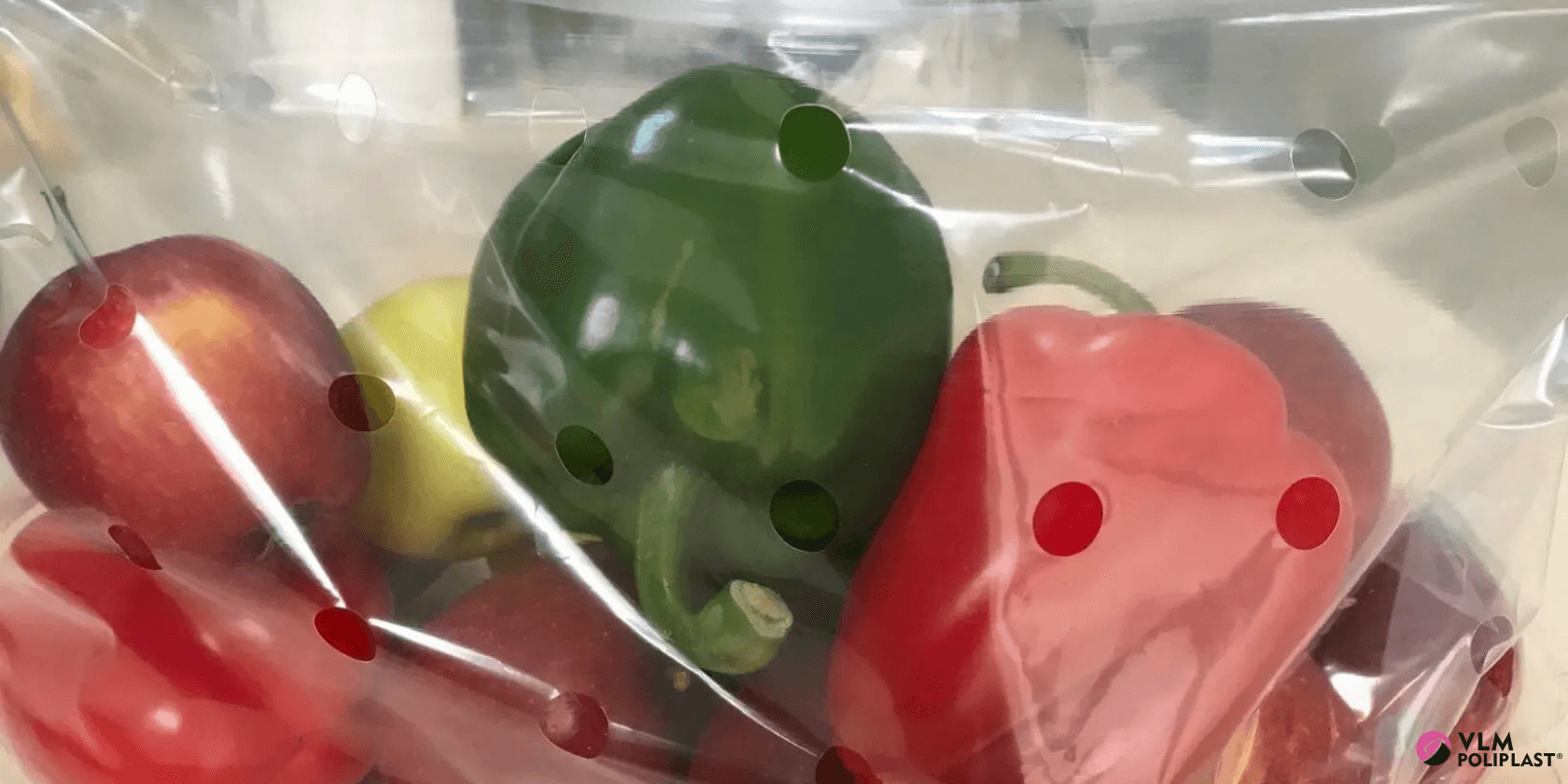
Macro or micro perforation
Macro-perforated film
Holes visible to the eye. Free air exchange, moisture leaves the pack quickly. For produce that respires intensely and needs no controlled atmosphere: tomatoes, peppers, cucumbers, mushrooms, herbs, apples, citrus.
Micro-perforated film
Holes too fine to see. Restricted, controlled air exchange that balances oxygen and carbon dioxide inside the pack. For bagged salads, berries and products that need a longer shelf period.
Neither variant holds an injected gas mixture. Micro perforation can balance the atmosphere in the pack with the produce’s own respiration, but if your product needs flushed gases kept inside, the right structure is a barrier film for modified atmosphere, and we will quote that instead of a perforated one.
Which configuration fits your produce
| Packed produce | Typical starting material |
| Spinach, rocket, herbs, salads | Transparent BOPP, for clarity on the shelf |
| Tomatoes, peppers, cucumbers, mushrooms | BOPP or polyethylene |
| Apples, pears, citrus, potatoes | Polyethylene, tougher in handling |
| Long-distance distribution and export | A tougher PE or laminated structure, for mechanical strength |
The material follows the produce; the perforation configuration, hole diameter, density and layout, across the full width or in ventilation bands, is set at quotation, from the respiration rate of the product and the pack format. Both base films have their own pages: polyethylene film in depth and BOPP film in depth.
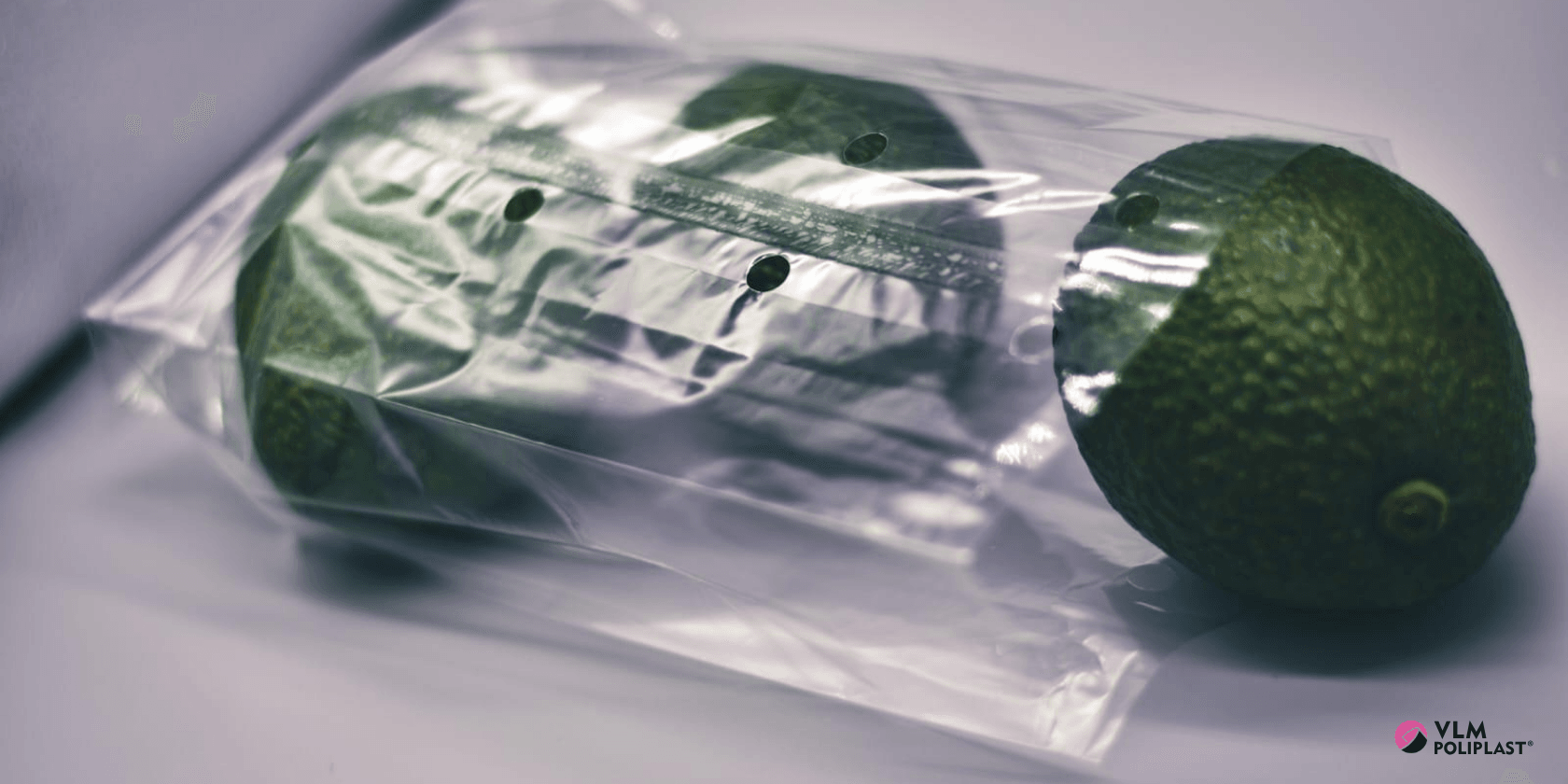
The printed white band: fixed branding, variable data
Produce data changes with every lot: best-before date, batch, weight, packing date. None of it can be pre-printed on a large film run, because it would expire with the lot. The answer is a white band printed on the transparent film, on which you overprint those details at packing time, on your own line.
Everything constant, your logo, the barcode, the origin, is pre-printed by us in 1-8 colours outside the band, and the rest of the film stays transparent so the produce sells itself at the shelf. Fixed information printed once, variable information printed per lot, and no pre-printed stock made obsolete by a date change.
The band width and its position on the roll are set from the pack format and the position of the print head on your line, so the band lands in the same place on every finished pack.
Order specifications
| Parameter | What we configure |
| Material | BOPP, polyethylene or laminated structure |
| Perforation | Macro or micro, across the full width or in ventilation bands. Diameter and density set at quotation, per product |
| Thickness | From 25 microns (µm), set by the produce and the mechanical demand |
| Width | Slit to the working width of your line, on separate rolls for separate lines |
| Printing | 1-8 colours for fixed information, white band for lot-variable data printed at packing, or unprinted |
| Documents | Technical datasheet, migration reports with the global migration analyses carried out at IBA Bucharest, and food-contact declaration under Regulation (EU) No 10/2011, in English |
| Minimum quantity and lead time | Confirmed at quotation, for the configuration requested |
Perforation is done in-house and stays uniform along the whole roll, so the film runs consistently on the packing line. Who we are and how we work is on the about page.
Frequently asked questions
Does perforation weaken the film on the packing line?
Perforation does not weaken the film on the line when the base film is dimensioned for the produce. The hole layout is designed together with the material and the thickness, so the strength stays where the machine and the handling need it; for heavier produce the answer is a tougher polyethylene or a laminated structure, not fewer holes.
Is perforated film recyclable?
Perforation does not change the material, so the film follows the recycling stream of its structure: a single-material polyethylene film is designed for the polyethylene stream, and a single-material BOPP film for the polypropylene stream. Recyclability is assessed on the complete pack and declared per ordered structure; VLM Poliplast does not issue a certified RecyClass class.
How is a new perforated film validated before a series order?
A new perforated film is validated with a trial roll on your own line. The sample run confirms the film behaves at your speeds, and the packed produce shows quickly whether the ventilation matches how it actually respires. If condensation still appears, the configuration is adjusted before the series order.
Request a quote for perforated film
Describe in your own words what happens to the produce at the shelf. The configuration discussion starts from the problem, not from a form template.
Related resources
All packaging film
The full film range for automated packaging lines, perforated variants included.
PPWR, Regulation (EU) 2025/40
What the EU packaging regulation means for produce packers, and the deadlines that apply.
About VLM Poliplast
The company, the certifications and how we work with food producers across the EU.
Losing produce to condensation at the shelf?
Send us the product, the pack format and the perforation configuration you use today. We check whether the ventilation is dimensioned correctly for how the produce actually respires.