



Custom coffee packaging with a degassing valve
Coffee packaging has to do three things at once, and one of them contradicts the other two. It has to keep oxygen and light out, so the natural fats in roasted coffee do not go rancid and the aroma stays in. It has to keep moisture out, which is what stales ground coffee and soluble powders. And it has to let carbon dioxide out, because coffee keeps releasing it for days after roasting. That third requirement is what the one-way degassing valve solves, and it is why coffee packaging is not simply high-barrier packaging.
VLM Poliplast manufactures custom coffee packaging in Bucharest for roasters, private label operations and industrial producers across the European Union: doypack, quad seal and pillow bags with a CO₂ valve, kraft bags, vacuum bags, and film for automatic VFFS and HFFS lines in widths from 100 to 1300 mm. Printed 1–8 colours to your artwork, or supplied unprinted for roasters who apply their own labels.
Lamination, slitting, pouch making, valve application and roll configuration are done in-house. Coffee is one of the sectors on the industries page. If you already know your specification, go straight to the quote form.
ISO 9001, ISO 22000, ISO 14001 and ISO 45001 · Migration testing at an independent third-party laboratory · No intentionally added PFAS, in line with Article 5 of Regulation (EU) 2025/40 · CO₂ valve applied in-house on any bag format · Printed 1–8 colours · Widths 100 to 1300 mm · EU manufacturer
Who this page is for
Coffee producers and distributors specifying flexible packaging for retail, HoReCa and export on the European market: specialty and artisan roasters ordering printed doypack and quad seal valve bags, industrial producers buying barrier film by the tonne for ground coffee, whole bean and instant coffee brands, private label and co-packing operations, and capsule brands that need the outer retail pouch. VLM Poliplast supplies the packaging, not the capsules.
What decides the structure
Four things, in this order: the coffee type, the target shelf life, the distribution conditions, and the packing line. Whole bean and ground coffee behave differently, because grinding exposes far more surface to oxygen and moisture. Export and long rotations ask more of the barrier than a local retail circuit does.
The table below groups the usual applications and the structures that answer them. It is where a specification starts, not where it ends.
| Application | What it needs most | Usual structure | Usual format |
| Ground coffee, long rotation and export | The highest oxygen barrier, full opacity | Metallised laminate | Doypack or quad seal with CO₂ valve |
| Specialty and single origin whole bean | Oxygen barrier with a transparent structure | PET/EVOH/PE laminate | Doypack with CO₂ valve |
| Whole bean, standard retail | A balanced barrier at controlled cost | Metallised BOPP/PE | Pillow bag or doypack |
| Instant coffee and soluble blends | Moisture barrier above all, small portions | Metallised BOPP/CPP | Pillow bag, or film for stick lines |
| Premium retail with a kraft look | Shelf presence, with a real barrier behind it | Kraft laminate with a sealant layer | Kraft doypack, with or without valve |
| Ground coffee packed as a vacuum brick | Full air removal, seal integrity | High-barrier vacuum laminate | Vacuum bag, coffee degassed before packing |
| Brands preparing the PPWR recyclability criteria | A single polymer family, with barrier inside it | PP/EVOH/PP EcoMonoFilm® | Doypack or quad seal with CO₂ valve |
| Automatic lines, any coffee type | Consistent behaviour at line speed | Laminate matched to the line | Film slit to your line width |
Barrier is described qualitatively here and documented per structure on its technical data sheet. The shelf life is declared by the roaster, from testing on the finished product; what the pack has to do is hold its seal and its barrier for the whole declared period. The structure is confirmed on your own coffee and your own line before the series order.
Formats and thicknesses
Thickness follows the fill weight, the format and the line. The ranges below are the typical ones in production. How the layers work together is on multilayer laminated structures.
| Format | Where it is used | Typical total thickness |
| Doypack | Ground and specialty whole bean, premium retail | 110 to 140 microns (µm) |
| Quad seal bag | Whole bean export, premium retail, four printable panels | 120 to 150 µm |
| Kraft doypack | Premium retail with a paper look | Around 110 µm |
| Pillow bag | Whole bean standard retail, instant coffee | 80 to 110 µm |
| Vacuum bag | Ground coffee bricks, retail and HoReCa | Confirmed per application |
| Film for VFFS lines | Whole bean or ground, high volume | 70 to 110 µm |
| Film for stick and single-serve lines | Instant coffee and 3-in-1 blends, formed on your line | 60 to 90 µm |
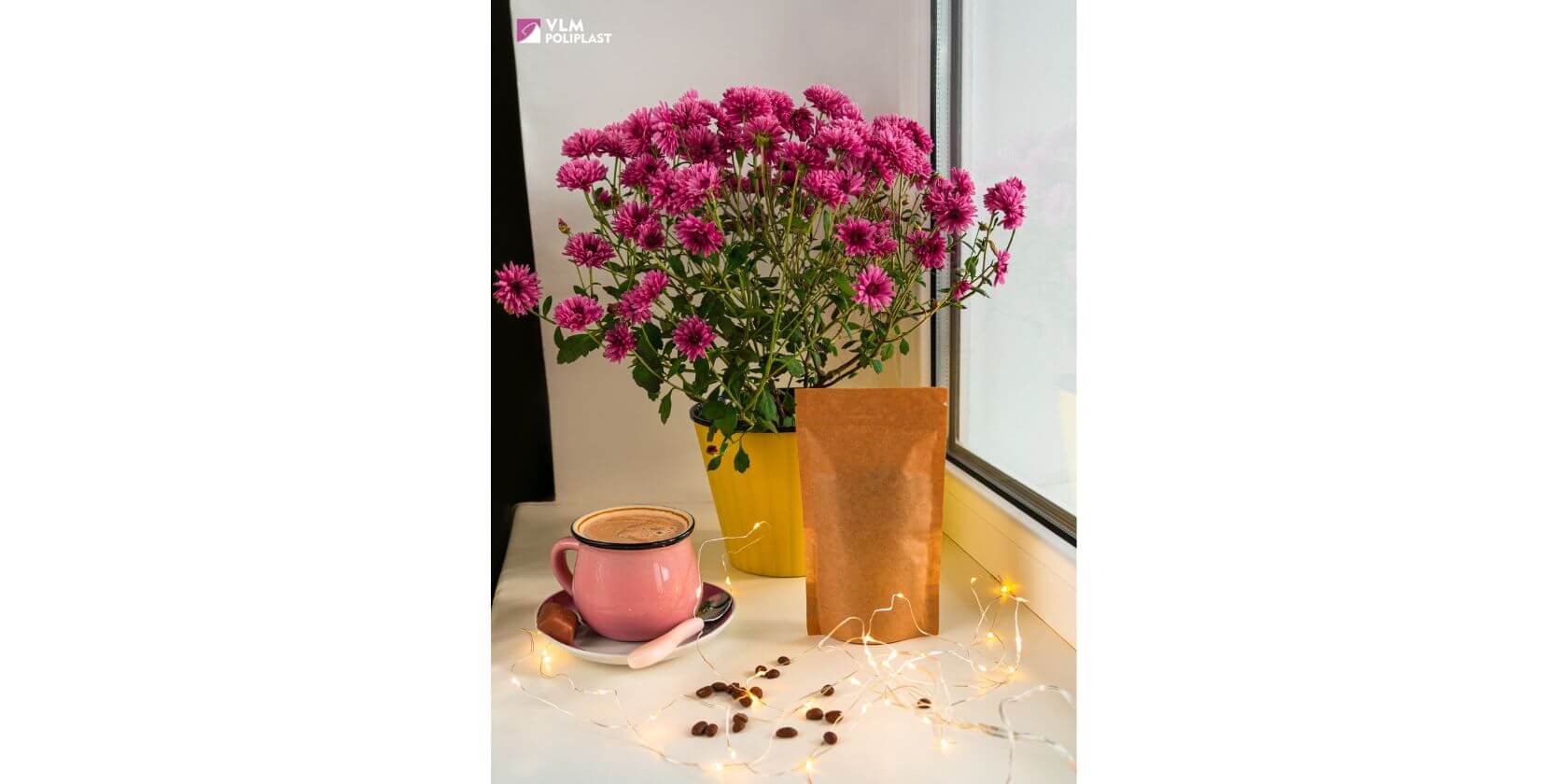
Specifying the degassing valve
The valve is applied in-house, on any bag format in production, before delivery, including on pillow bags. Its diameter is 10 to 11 mm and it is compatible with metallised structures, EVOH laminates, kraft laminates and EcoMonoFilm® monomaterial.
It works independently of the closure, which is why valve and zipper are usually specified together: the valve handles the CO₂ before the pack is opened, the zipper handles air exposure afterwards. Where the pack should open without scissors, a tear notch or an extended easy-open zone is added at the top.
What you decide at quotation: whether the coffee is packed within days of roasting or rested first, the bag format, and whether the pack also needs a zipper and a tear notch.
Valve bag or vacuum brick
Valve bag
For coffee packed within days of roasting. The CO₂ leaves through the valve, oxygen stays out, the bag keeps its shape. The standard for artisan roasters and premium retail, on doypack, quad seal and pillow formats.
Vacuum brick
For ground coffee rested and degassed before packing. Removing the air slows the oxidation of the natural fats, and the pack hardens into the familiar brick. The standard for industrially ground coffee in retail and HoReCa.
The two answer different production situations rather than competing. A vacuum pack needs the coffee to finish degassing first, otherwise the released CO₂ softens the brick; the valve bag removes that waiting time and keeps the aroma that would escape during open-air resting.
Kraft coffee bags
A kraft coffee bag is not a paper bag. The kraft layer gives the look and the print surface; the barrier comes from the laminate behind it, with a sealant layer that manages oxygen and moisture, because paper on its own protects coffee from neither.
Kraft doypacks are produced with or without the CO₂ valve, with or without a transparent window, printed 1–8 colours directly on the kraft surface, where matte inks keep the natural appearance. For buyers comparing kraft with fully paper-based packaging under the PPWR design-for-recycling criteria, the evaluation runs per structure: what decides it is the composition of the layers behind the paper, not the kraft surface.

Bags for the roastery, film for the line
Ready-made bags suit manual and semi-automatic packing and carry the valve applied in production. Automatic lines take film, and the pack is formed on the machine, so the film is slit to the working width of your line and calibrated to it.
| Line | What we supply | Typical applications |
| Vertical form-fill-seal (VFFS) | Film, widths 100 to 1300 mm | Whole bean and ground coffee in pillow bags, high volume |
| Horizontal form-fill-seal (HFFS) | Film for stick and flow-pack lines | Instant coffee and 3-in-1 blends, formed on your line |
| Preformed bag lines | Doypack or quad seal, valve applied | Ground and specialty whole bean, premium retail |
| Manual and semi-automatic packing | Doypack, quad seal or pillow bag | Roasters packing in-house, retail and HoReCa formats |
Film is calibrated to your line: sealing temperature, coefficient of friction and unwind tension. Send those parameters with the specification and they are recorded on the technical data sheet delivered with the order.

The monomaterial route: EcoMonoFilm®
EcoMonoFilm® covers single-family polyethylene and polypropylene structures, including variants with an EVOH barrier layer inside the same family. For coffee, the reference is PP/EVOH/PP: a polypropylene laminate whose oxygen barrier comes from a thin internal EVOH layer, which keeps the structure based predominantly on one polymer family and designed to support NIR identification and compatibility with the PP recycling stream. The PE variant is used for film on automatic lines; both are described on monomaterial PP and monomaterial PE.
Nothing changes in your process: the same doypack and quad seal formats, the same valve applied in production, the same print, the same film widths for VFFS lines.
Where it fits and where it does not is decided per product, on your coffee and your distribution, not by category. A single-family structure carries less oxygen barrier than a mixed laminate, so the question is whether your coffee, your rotation and your storage conditions leave room for that. We say so at quotation, before the artwork, rather than afterwards. VLM Poliplast does not issue a certified RecyClass class, and recyclability is assessed on the complete pack.
Printing and sizes
Coffee bags are printed 1–8 colours to your artwork, with gloss, matte or soft-touch finish and Pantone colours on request, including printing directly on the kraft surface. Unprinted bags in the same structures are available for roasters who apply self-adhesive labels. For custom artwork, the technical team supplies the dielines per format.
The dimensions below are the typical retail configurations, as a starting point. They are adjusted per product, because bean density, grind and the presence of a valve and zipper change the volume the pack has to hold: whole beans take more room than ground coffee at the same weight.
| Fill weight | Usual format | Typical dimensions, width x height + base gusset |
| 100 to 150 g | Doypack | 110x190x80 mm or 135x210x80 mm |
| 250 g | Doypack or quad seal | 130x190x80 mm up to 160x270x80 mm |
| 500 g | Doypack or quad seal | 180x280x80 mm |
| 1 kg | Quad seal or pillow bag | 200x300x90 mm up to 220x330x90 mm |
Compliance
Structures in direct contact with coffee comply with Regulation (EC) No 1935/2004 and Regulation (EU) No 10/2011, as amended by Regulation (EU) 2025/351, in force since 16 March 2025. Overall and specific migration testing is carried out at an independent third-party laboratory, with the food simulants set out in Regulation (EU) No 10/2011, coffee being a food with variable fat content and acidity. Each laminated structure is delivered with its declaration of conformity and its technical data sheet; what the declaration contains is on the PPWR declaration of conformity page.
Regulation (EU) 2025/40, the PPWR, applies from 12 August 2026 to all packaging placed on the EU market. Recyclability performance grades apply from 1 January 2030. Structures carry no intentionally added PFAS, in line with Article 5, which applies from 12 August 2026; the restrictions are on the PFAS in food packaging page, and the full timeline on the EU packaging regulation page.
Production runs under ISO 9001:2015, ISO 14001:2015, ISO 22000:2018 and ISO 45001:2018.
What you send, what you get back
What you send
Coffee type: whole bean, ground, instant or blends · Fill weight and estimated monthly volume · The required shelf life and the distribution conditions · Whether the coffee is packed within days of roasting or rested first · Packing line: VFFS, HFFS, preformed bag, vacuum, semi-automatic or manual · Features: valve, zipper, tear notch, window · Print: number of colours, or unprinted
What you get back
A format and structure proposal for your coffee · Full specifications: dimensions, structure, thickness, sealing parameters · How the structure is treated at end of life, stated plainly · Food-contact documentation for the structure · Order conditions confirmed at quotation · An unprinted sample from our own stock, for a trial run on your line
Changing your coffee pack, or launching a new roast?
Send the coffee type, the fill weight and the packing line. We come back with the format and the structure.
Frequently asked questions
What is a degassing valve?
A one-way vent fitted to a coffee bag. It lets the carbon dioxide that roasted coffee releases escape from the pack, and blocks outside air from coming in. Without it, coffee packed soon after roasting swells the bag; without the one-way function, oxygen would enter and stale the coffee.
How do coffee bag valves work?
The valve opens under the slight internal pressure that the CO₂ creates, vents the gas, then closes. Because it works in one direction only, ambient oxygen and moisture cannot flow back in. It operates on its own, whether or not the bag has a zipper.
Why is coffee not vacuum-sealed anymore?
Vacuum packing needs the coffee to finish releasing CO₂ before sealing, which means resting it in open air, where aroma escapes. Valve bags removed that wait. Vacuum bricks are still used for industrially ground coffee that is degassed under controlled conditions before packing.
What does coffee packaging protect against?
Oxygen and moisture, first. Oxygen oxidises the natural fats in roasted coffee and flattens the aroma; moisture stales ground coffee and soluble powders. Light comes third, which is why most coffee structures are opaque or metallised.
How long will coffee stay fresh in a sealed bag?
The shelf life is declared by the roaster, from testing on the finished product, not by the packaging supplier. What changes it is the coffee itself, the storage conditions and the barrier of the structure. The pack's job is to hold its seal and its barrier for the whole declared period, and that is what it is specified against.
What is the sustainable option for coffee packaging?
On the European market the practical direction is packaging designed for recycling: structures based predominantly on one polymer family, such as PP/EVOH/PP, which stay compatible with an existing sorting stream while still carrying an oxygen barrier. Under Regulation (EU) 2025/40, recyclability performance grades apply from 1 January 2030, which is why roasters are evaluating the change now.
What is the minimum order quantity?
It varies with format, structure, dimensions and the number of print colours, and printing is committed at series level. Send the specification and we confirm the minimum for that exact configuration before you plan the artwork.
Can you send samples before the first order?
Yes. We send unprinted samples from our own stock, so you can check the structure and the format and run them on your line before committing. Samples do not carry your artwork, because printing is committed at series level.
What documents come with the delivery?
A technical data sheet for the structure, a certificate of conformity, and for food contact a declaration of compliance under Regulation (EC) No 1935/2004 and Regulation (EU) No 10/2011. How the structure is treated at end of life is stated in the same documentation.
Related resources
Structures
Multilayer laminated structures
What each layer does in a barrier laminate, and how the combination is chosen.
Barrier
Metallised film
The fine metallic layer that gives opacity and the highest barrier in our coffee structures.
Recyclability
Monomaterial PP
The polypropylene route behind EcoMonoFilm®, with barrier and sealing behaviour.
Format
Quad seal bags
Four printable panels and a stable standing shape, for export and premium retail.
Regulation
EU packaging regulation (PPWR)
What Regulation (EU) 2025/40 changes for producers, and when each requirement applies.
Industries
All industries served
Bakery, fresh produce, pet food, supplements and fishing bait, each with its own structure logic.
Request your custom quote
The coffee type, the fill weight and the packing line are enough to start. Whether the coffee is packed within days of roasting or rested first changes the answer, so say which.
Printed 1–8 colours · Unprinted samples from stock · Widths 100 to 1300 mm · ISO 9001, 14001, 22000, 45001