

'/%3E%3C/svg%3E)

PFAS in food packaging: what the PPWR limits reach
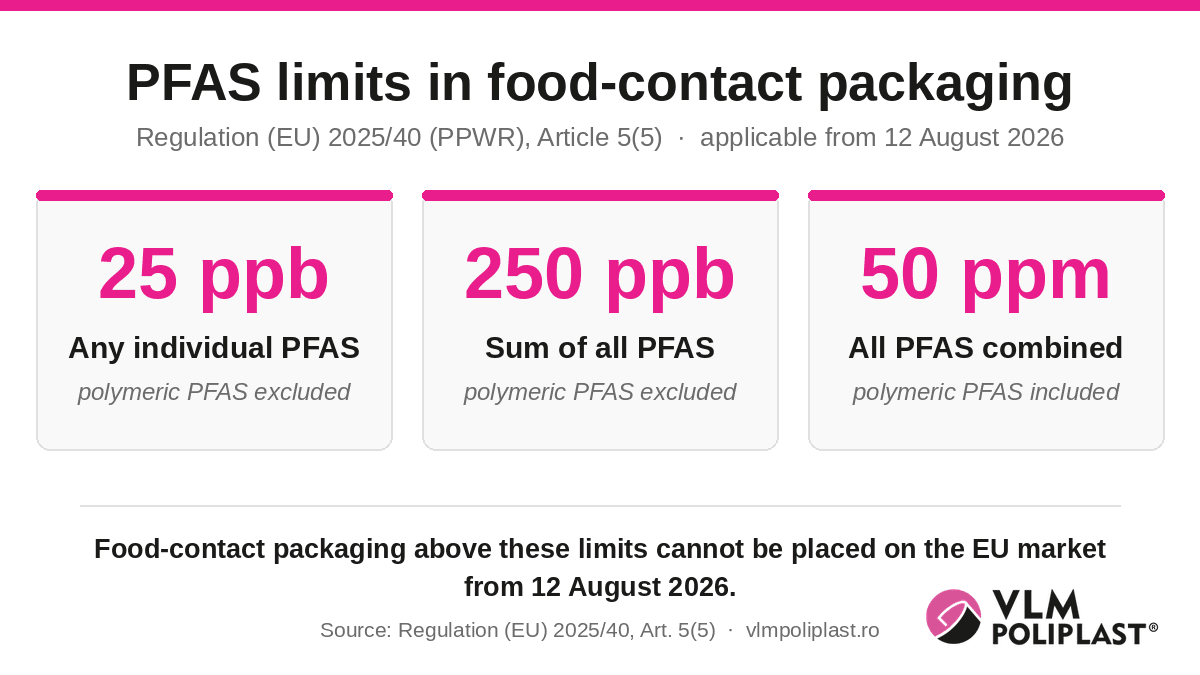
Article 5(5) of Regulation (EU) 2025/40 sets three concentration limits for PFAS in food packaging, defines PFAS structurally, and applies from 12 August 2026. Food-contact packaging cannot be placed on the Union market at or above three values. They are 25 ppb for any single PFAS, 250 ppb for the sum, and 50 ppm for PFAS including polymeric ones.
The material does not matter. Coated paper, board, plastic film, laminates and composites are all in scope when the packaging is intended to touch food. What changes between them is where the fluorine comes from, and whether a fluoropolymer coating counts.
This page takes the material route, not the paperwork route. It covers which limit catches PTFE. It explains why fluorochemicals were applied to fibre. It sets out what a PFAS-free claim can and cannot mean. And it places the limit on PFAS in food packaging beside the wider REACH proposal.
Two limits exclude polymers, the third one counts them
The three values that govern PFAS in food packaging are not three ways of saying the same thing. They differ in what they measure, and the difference decides whether a fluoropolymer coating is visible at all.
Targeted analysis, substance by substance. Polymeric PFAS are excluded from quantification, so this limit catches the mobile acids, the PFOA family and their relatives.
The same targeted analysis, summed, where applicable with prior degradation of precursors so that substances which break down into PFAS are counted. Polymers again excluded.
The wide net, and the only limit under which fluoropolymers appear. It is the value that matters for coatings and treatments built on fluorinated polymers.
The paragraph also carries its own structural definition. PFAS means any substance containing at least one fully fluorinated methyl (CF3-) or methylene (-CF2-) carbon atom, with no H, Cl, Br or I attached. A list of structural exceptions follows. The definition does not work from a substance list. That is why the Commission has said no CAS list will be published.
The trigger at 50 mg/kg is not a fourth limit
A fourth number sits beside the three without being a limit. The trigger sits at 50 mg/kg total fluorine. Above it, the upstream supplier must prove on request how much of that fluorine is PFAS. In REACH terms that supplier is the manufacturer, importer or downstream user. The proof feeds the Annex VII technical documentation.
One wording detail decides borderline results. The article reads “equal to or above”, so a measurement landing exactly on 25 ppb is already a breach, not the last acceptable value.
PTFE is a polymeric PFAS, so the third limit is the one that catches it
Teflon is a trade name for PTFE, and PTFE is a fluoropolymer. Under Article 5(5) it is excluded from quantification at 25 ppb and 250 ppb, and counted at 50 ppm. That single distinction answers most of the Teflon questions the market asks.
PTFE is not banned as a material in the Union, and cookware is not packaging, so it sits outside the PPWR entirely. What the Regulation does say concerns packaging. Food-contact packaging carrying PFAS at or above 50 ppm, polymeric included, cannot be placed on the market from 12 August 2026. So all PTFE is PFAS, while most PFAS are not PTFE.
A practical consequence for release liners, non-stick surfaces and fluoropolymer-coated papers: a targeted analysis coming back clean proves nothing about them. Only the total fluorine and total organic fluorine route reaches that far.
Why PFAS in food packaging started on paper, not on film
PFAS in food packaging were applied for one job: making paper and board resist grease and moisture. Cellulose is porous and hydrophilic, so a fast-food wrapper, a bakery paper or a microwave popcorn bag needs something to stop fat migrating through the sheet. Fluorochemical treatments did that at very low coat weights, without the stiffness a heavy coating adds.
Polyolefin films never needed the same chemistry. Polyethylene and polypropylene resist grease and moisture through the polymer itself and the structure of the laminate. That is why PFAS in food packaging concentrate on coated paper and board rather than on plastic film.
That does not make film automatically clean. Fluorine reaches a film structure through inks, varnishes, lamination adhesives, process aids and recycled content. The Commission is explicit on scope. The limits apply to the packaging unit as a whole. That includes the inks, varnishes, glues and adhesives the manufacturer places on the market.
What PFAS-free means for paper and what it means for film
The phrase carries different weight depending on the substrate. The difference is worth stating plainly before signing a specification.
| Route | How grease resistance is achieved | What to check |
|---|---|---|
| Mechanical | Densely refined cellulose. Greaseproof and glassine papers close the pore structure by beating the fibre, with no coating at all. | PFAS-free by design. A statement for the specific paper grade still belongs in the file. |
| Chemical | Non-fluorinated barrier coatings, dispersion or polymer based, applied to the sheet. | Coating chemistry declared by the converter, and whether repulpability was traded away for barrier. |
| Structural | Film lamination onto fibre, or an all-polyolefin structure where the polymer supplies the barrier. | Adhesive and ink declarations, since the fibre is no longer the risk carrier. |
| Fluorochemical | Fluorinated grease repellents on paper. The historical route, and the one the restriction targets. | Not compatible with Article 5(5) at the concentrations that make it work. |
Paper reaching grease resistance mechanically or through a non-fluorinated coating is PFAS-free by construction. Paper treated with fluorochemical repellents is not, whatever the wording on the delivery note. The reliable check for PFAS in food packaging is a statement for the specific grade, backed where needed by total fluorine screening below 50 mg/kg. Both routes are compared in more depth on paper-based packaging versus plastic.
Checking for PFAS in food packaging: supply chain first, laboratory second
The practical route rarely starts in a laboratory. It starts in the supply chain. Article 16 obliges suppliers to give the manufacturer the information needed to demonstrate conformity. The Commission states that suppliers cannot refuse to provide it.
Testing is the verification layer on top. Since no harmonised EU method exists, Commission guidance recommends a stepwise approach for enforcement, and the same logic works as a purchasing check.
| Step | Measurement | Outcome |
|---|---|---|
| Step 1 | Total fluorine quantification. Organic and inorganic fluorine together. | Below 50 mg/kg, the sample can be considered compliant and testing stops. |
| Step 2 | Pyrolysis-GC/MS, to separate organic fluorine from mineral salts. | Organic fluorine below 50 mg/kg indicates compliance with limit (c). |
| Step 3 | Targeted analysis with total oxidisable precursors, substance by substance. | Checks the 25 ppb and 250 ppb limits together. |
The Commission adds an observation that changes the cost calculation. Preliminary laboratory analyses on selected packaging items showed a clear pattern. In practice, only packaging where PFAS had been intentionally added returned results above the limit values. The restriction covers unintentional presence as well, but the real risk concentrates in treated, coated and fluorinated-ink structures.
No list of restricted PFAS with CAS numbers will be published. The limits apply to every PFAS falling under the Regulation’s definition. A statement naming a handful of substances therefore does not close the question. The evidence ends up in the Annex VII file behind the EU declaration of conformity.
The packaging limit and the REACH proposal run on separate tracks
Two regimes are routinely merged in reporting, and they are not the same thing. Article 5(5) is adopted law with a fixed date and a narrow scope: food-contact packaging, three concentration values.
The universal PFAS restriction under REACH is a proposal. Five Member States submitted the dossier to the European Chemicals Agency in January 2023. The Commission has said it will propose the restriction on the basis of the Agency’s opinion. It covers most uses of the substance family, well beyond packaging, and it is not in force.
The Regulation anticipates the overlap and puts a date on it. By 12 August 2030 the Commission must evaluate whether the paragraph needs amending or repealing. The purpose is to avoid overlaps with PFAS restrictions under Regulations (EC) No 1935/2004, (EC) No 1907/2006 and (EU) 2019/1021. Until then, the binding regime for PFAS in food packaging is Article 5(5).
Frequently asked questions
Is PFAS the same as Teflon?
No. Teflon is a trade name for PTFE, one substance inside a family of thousands. Article 5(5) defines that family structurally, by the fully fluorinated carbon atom. PTFE is a polymeric PFAS. Under Article 5(5) it is excluded from the 25 ppb and 250 ppb targeted limits, and counted toward the 50 ppm limit. All Teflon is PFAS; most PFAS is not Teflon.
Is PTFE banned in Europe?
Not as a material, and cookware sits outside the PPWR altogether. What Article 5(5) does is stop food-contact packaging at or above 50 ppm PFAS, polymeric included, from being placed on the market from 12 August 2026. A separate and much wider REACH restriction is under preparation but is not adopted law.
Which greaseproof paper is PFAS free?
Paper that gets its grease resistance mechanically, from densely refined cellulose, or from a non-fluorinated coating or film lamination. Paper treated with fluorochemical grease repellents is not. Ask for a PFAS statement covering the specific paper grade rather than the mill. Back it with total fluorine screening where the file needs it.
Do all butter wrappers contain PFAS?
No. A butter wrapper needs a grease barrier. That barrier can come from aluminium and paper laminates, from film-laminated or polymer-coated papers, or from dense greaseproof papers. None of those rely on PFAS. PFAS in food packaging appear where the grease resistance was achieved with a fluorinated coating.
Does the restriction apply in every Member State at once?
Yes. The PPWR is a regulation with direct effect, so the limits bind all 27 Member States from the same date without national transposition. National law can go further, and some of it already does. Denmark has banned PFAS in paper and board food-contact materials since 2020, under an order that predates the PPWR.
Does the packaging need re-testing for every delivery?
The Regulation sets no testing frequency. Statements and reports cover a material grade or a packaging type rather than a batch. A fresh check for PFAS in food packaging is forced by a change of formulation, raw material, process or supplier. The earlier result no longer describes what is being delivered.
Does the manufacturer or the brand owner carry the liability?
The manufacturer, in the sense the Regulation gives that word. The Commission puts it flatly. The manufacturer is the sole economic operator bearing legal responsibility for packaging compliance. That holds regardless of who actually drafted the declaration of conformity. Suppliers owe information under Article 16; they do not take on the liability.
Sources
Regulation (EU) 2025/40, as published in the Official Journal L of 22 January 2025. Article 5(2), 5(4), 5(5) and 5(6), Articles 15, 16 and 39, and Annexes VII and VIII. The Commission Notice in the Official Journal C, 2026/3084 of 10 June 2026, section 5. It covers the stepwise testing approach and the treatment of stock. The Commission FAQ of 3 August 2026 for the scope of the limits across inks, varnishes, glues and adhesives. The same FAQ for the absence of a published CAS list, the preliminary laboratory findings and the allocation of legal responsibility. Regulation (EC) No 1907/2006 for the REACH definitions in Article 3, points 9, 11 and 13. Regulation (EU) 2019/1020 for market surveillance. Danish Order BEK no. 681 of 25 May 2020 on retsinformation.dk. Every article reference was checked against the official text rather than secondary sources.
Related resources
The full framework: deadlines from 2026 to 2038, obligations per operator, and the impact on flexible packaging.
→ Read the guide
Article 39 and Annex VIII: who signs it, which fields it carries, and how long it is archived.
→ See the structure
Polymeric PFAS, total fluorine, total organic fluorine, NIAS and the rest of the vocabulary.
→ Open the glossary
Barrier, recyclability and coating data for the substitution route that runs straight through the PFAS question.
→ Compare the two
The category where grease resistance is a specification, and where the substitution question is sharpest.
→ See the application
High-barrier laminates where inks, adhesives and valves all enter the same technical file.
→ See the application
Questions about the documentation for the structures we supply.
Content reviewed by Laura Ionescu · 17.08.2026