



Custom supplement packaging
Supplement packaging is decided by moisture before anything else. Powders take water straight out of the air, and caking starts at the first opening, not on the shelf, which is why the pack has to hold its barrier and reclose reliably for weeks of daily use. Oxygen matters next, for probiotics, omega-3 and other sensitive actives, and light matters for photosensitive formulas. Capsules, tablets and gummies ask less of the barrier and more of the presentation.
VLM Poliplast manufactures custom supplement packaging in Bucharest for brands, private label operations and contract packers across the European Union: stand-up pouches with ziplock, quad seal bags, three-side seal pouches, kraft pouches with a window, and barrier film for automatic VFFS, HFFS and stick lines in widths from 100 to 1300 mm. Printed 1–8 colours to your artwork, or unprinted for brands that apply self-adhesive labels.
One distinction is worth stating plainly, because it is not obvious from a search result: VLM Poliplast makes the packaging, not the supplement. Many companies ranking on this term are contract manufacturers who formulate and fill; we are the converter that produces the pouches, bags and film those products go into.
Lamination, slitting, pouch making and roll configuration are done in-house. Supplements are one of the sectors on the industries page. If you already know your specification, go straight to the quote form.
ISO 9001, ISO 22000, ISO 14001 and ISO 45001 · Migration testing at an independent third-party laboratory · No intentionally added PFAS, in line with Article 5 of Regulation (EU) 2025/40 · Printed 1–8 colours · Widths 100 to 1300 mm · EU manufacturer
Who this page is for
Supplement producers and distributors specifying flexible packaging for retail, e-commerce and export: sports nutrition brands ordering ziplock pouches and quad seal bags for protein powders, vitamin and capsule brands buying doypacks, producers of single-dose formats who buy film for their own stick and sachet lines, private label operations, and contract fillers sourcing the packaging their clients' products go into.
What decides the structure
The product form comes first: a hygroscopic powder, a capsule, a gummy and an oxidation-sensitive active are four different briefs. Then the shelf life, the distribution conditions and the packing line. Hygroscopic powders, creatine, electrolytes, many amino acid blends, take moisture directly from the surrounding air, so for them the moisture barrier and the reclosure decide the outcome, not the seal alone.
| Application | What it needs most | Usual structure | Usual format |
| Protein powder, retail 500 g to 2 kg | Moisture barrier and reliable reclosing | High-barrier laminate | Stand-up pouch with ziplock |
| Bulk sports nutrition, 2 to 5 kg | Seam strength under heavy fill, stable base | High-barrier laminate | Quad seal bag with ziplock |
| Capsules, tablets, standard vitamins | A moderate barrier and a dependable closure | Single-family PP or PE laminate | Doypack with ziplock |
| Probiotics and oxidation-sensitive actives | Oxygen barrier above all | PE/EVOH/PE or PP/EVOH/PP | Doypack with ziplock |
| Hygroscopic powders: creatine, electrolytes | The highest moisture barrier, tight reclosing | Metallised laminate | Doypack or quad seal with ziplock |
| Premium capsules and gummies | Shelf presence, product visible, hanging display | Kraft laminate with a sealant layer | Kraft pouch with window, ziplock and eurohole |
| Single doses: stick packs and sachets | Seal integrity, behaviour at line speed | Metallised or polyester laminate | Film slit to your line width |
| Brands preparing the PPWR recyclability criteria | One polymer family, with barrier inside it | PP/EVOH/PP or PE/EVOH/PE EcoMonoFilm® | Doypack or quad seal with ziplock |
Barrier is described qualitatively here and documented per structure on its technical data sheet. The shelf life is declared by the supplement producer, from testing on the finished product. The structure is confirmed on your own product and your own line before the series order.
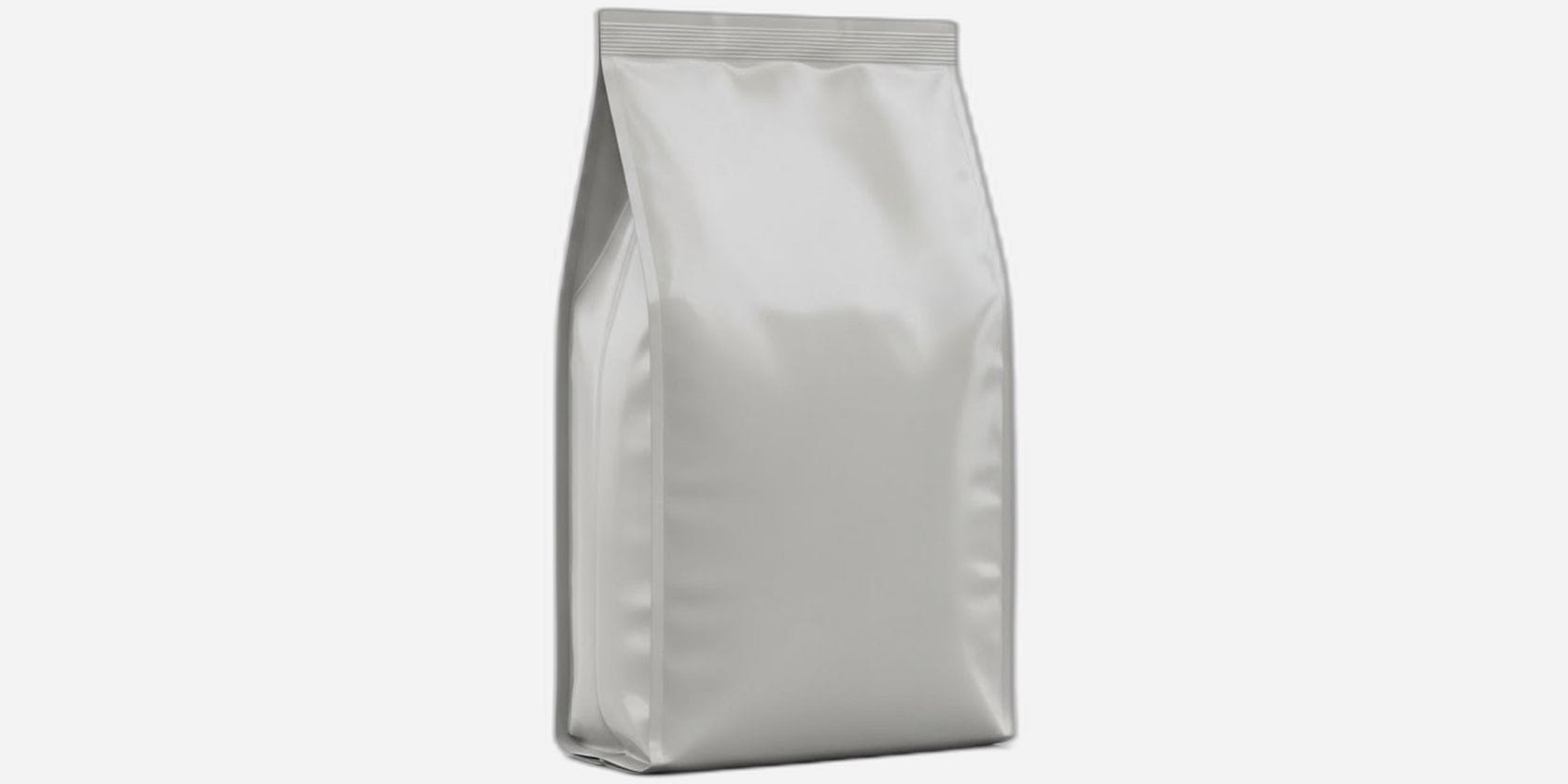
Pouch, jar or tub compared on six criteria
For most retail protein products between 500 g and 2 kg, the answer is a stand-up pouch with a ziplock on a high-barrier laminate. Rigid jars protect well and stack predictably, but they ship empty at full volume and use more plastic per serving. The comparison below is from the flexible packaging side, stated as it is.
| Criterion | Pouch or quad seal bag | Rigid jar or tub |
| Barrier | Set by the laminate, from a standard structure to EVOH and metallised | Set by the wall and the closure; usually needs an induction seal |
| Reclosing | Press-to-close ziplock, for daily use across the whole pack | Screw cap, dependable but bulkier |
| Logistics | Ships flat before filling, low packaging weight per unit | Ships empty at full volume, higher freight and storage cost |
| Material per serving | Less plastic per serving, single-family versions available | More plastic per unit, recyclable where collection exists |
| Shelf presence | Print across the whole surface, stands upright, window option | Wrap label or direct print, a familiar premium look |
| Bulk fills, 2 to 5 kg | Quad seal bag: square under load, four printable panels, 3-finger handle | Large tubs: heavy, high shipping volume |
One practical note from production: what protects a powder is the barrier of the laminate and the integrity of the seal, not the rigidity of the container. A barrier pouch with a properly welded ziplock holds the product in specification for its declared shelf life at a fraction of the packaging weight.
Ziplock and the other closures
On a supplement pack the closure is not an accessory. The pack is opened daily, often with wet hands and a scoop, and the barrier only counts if the pack shuts properly afterwards. The press-to-close ziplock is welded into the pouch during converting, not applied afterwards, which is what keeps it aligned with the seal.
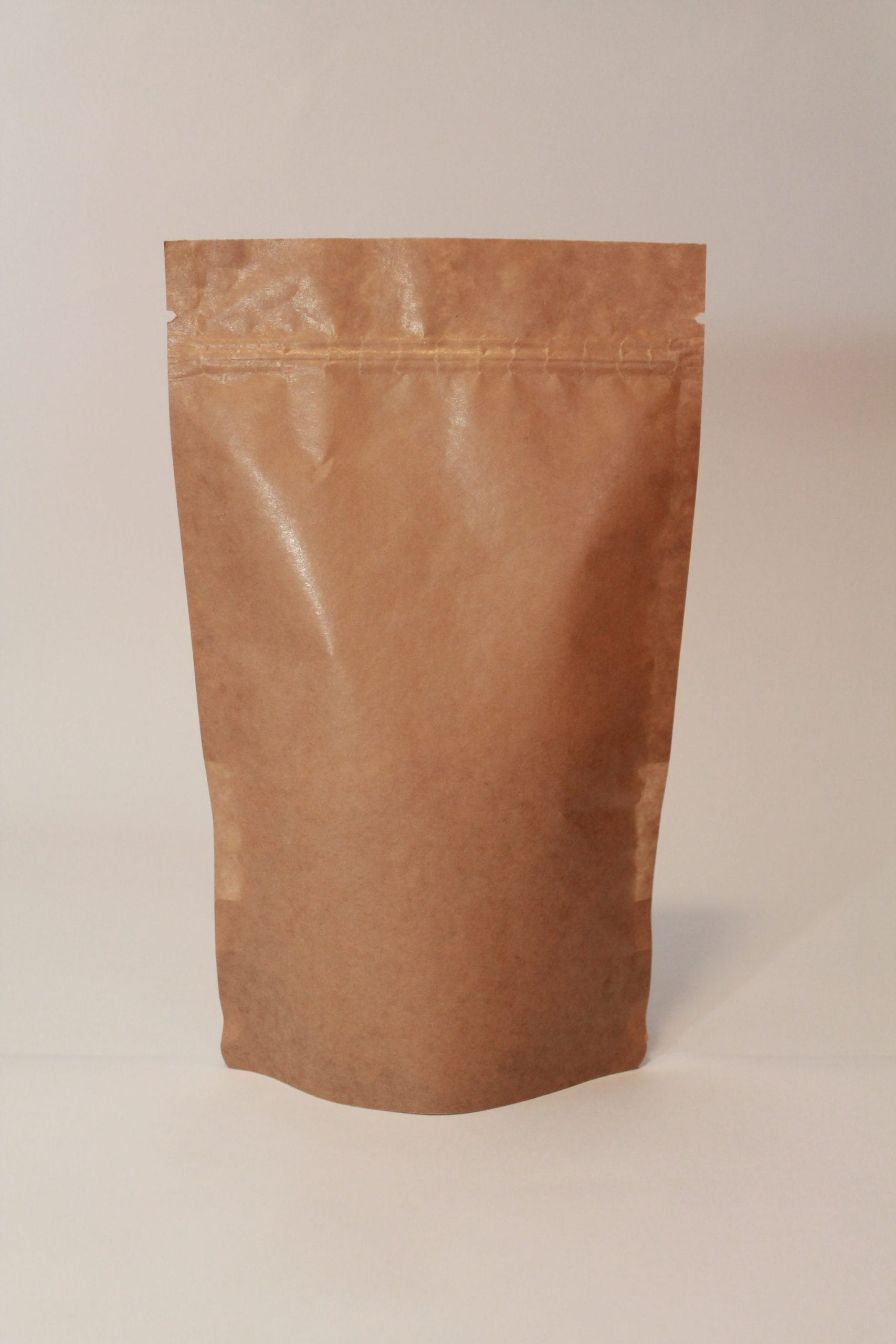
Combined with it: an easy-open tear notch above the zip, so the pack opens without scissors and the zip stays intact; a eurohole where the product hangs on a display rack; a clear window on kraft and printed pouches, where the product itself sells; and a cut or 3-finger handle on bulk quad seal bags. Which of them you need follows the retail channel and the fill weight, and they are specified together with the structure.
The monomaterial route: EcoMonoFilm®
EcoMonoFilm® covers single-family polyethylene and polypropylene structures, including variants with an EVOH barrier layer inside the same family. They are based predominantly on one polymer family and designed to support NIR identification and compatibility with the PE or PP recycling stream, following the RecyClass design-for-recycling guidelines. Both routes are described on monomaterial PP and monomaterial PE.
Supplements sit in a good position for this change, because capsules, tablets and gummies rarely need the highest barrier. The harder cases are hygroscopic powders and oxidation-sensitive actives, where the question is whether your product, your rotation and your storage conditions leave room for a single-family structure.
That is decided per product, at quotation, before the artwork. VLM Poliplast does not issue a certified RecyClass class, and recyclability is assessed on the complete pack. The timeline is on the PPWR guide.
Pouches for filling, film for the line
Ready-made pouches are delivered with the ziplock and the features already in place, for manual and semi-automatic filling. Single-dose formats are different: sticks and sachets are formed, filled and sealed on your own line directly from film, which is why they are supplied as film and not as finished packs.
| Line | What we supply | Typical applications |
| Vertical form-fill-seal (VFFS) | Film, widths 100 to 1300 mm | Powders and granulates in pillow bags, high volume |
| Stick and sachet lines (HFFS) | Film for single-dose formats | Single servings, samples, travel packs, formed on your line |
| Preformed pouch lines | Doypack or quad seal with ziplock in place | Protein powders, capsules, gummies, retail formats |
| Manual and semi-automatic filling | Doypack, quad seal, three-side seal, kraft pouch | Smaller brands and private label runs |
Film is calibrated to your line: sealing temperature, coefficient of friction and unwind tension. Send those parameters with the specification and they are recorded on the technical data sheet delivered with the order.
Compliance
Food supplements themselves are governed by Directive 2002/46/EC. Their packaging falls under the food-contact framework: Regulation (EC) No 1935/2004 and Regulation (EU) No 10/2011, as amended by Regulation (EU) 2025/351, in force since 16 March 2025. Overall and specific migration testing is carried out at an independent third-party laboratory, and each structure is delivered with its declaration of conformity and technical data sheet; what the declaration contains is on the PPWR declaration of conformity page.
Regulation (EU) 2025/40, the PPWR, applies from 12 August 2026 to all packaging placed on the EU market, and recyclability performance grades apply from 1 January 2030. Structures carry no intentionally added PFAS, in line with Article 5, which applies from 12 August 2026; the restrictions are on the PFAS in food packaging page.
Production runs under ISO 9001:2015, ISO 14001:2015, ISO 22000:2018 and ISO 45001:2018.
What you send, what you get back
What you send
Product form: powder, capsule, tablet, gummy or liquid · Whether the formula is hygroscopic, oxidation-sensitive or photosensitive · Fill weight and estimated monthly volume · The required shelf life · Filling line: VFFS, stick or sachet, preformed pouch, semi-automatic or manual · Features: ziplock, easy open, eurohole, window, handle · Print: number of colours, or unprinted
What you get back
A format and structure proposal for your product · Full specifications: dimensions, structure, thickness, sealing parameters · How the structure is treated at end of life, stated plainly · Food-contact documentation for the structure · Order conditions confirmed at quotation · An unprinted sample from our own stock, for a trial run on your line
Powder caking after the first opening?
That is usually the closure, not the film. Send the formula type, the fill weight and the filling line, and we come back with the structure.
Frequently asked questions
What is the best packaging for protein powder?
A stand-up pouch with a ziplock on a high-barrier laminate, for most retail fills between 500 g and 2 kg. It combines the moisture barrier the powder needs with reclosing that survives daily use, and it ships flat before filling. For bulk fills of 2 to 5 kg, the quad seal bag gives a stable four-panel construction and a carry handle.
Does protein powder need to be sealed?
Yes, twice over. It needs a hermetic heat seal for the shelf life before opening, and a reclosure system for the weeks after it. Powder takes moisture from the air, and caking usually starts once the pack is in daily use, which is why the ziplock is welded into the pouch rather than added to it.
Can I store protein powder in a plastic bag?
Only if it is a barrier bag. A generic plastic bag offers no meaningful moisture or oxygen barrier, so the powder clumps and degrades. A laminated barrier pouch with a welded ziplock is a different construction entirely, and it is what the product is specified against.
What is sachet packaging?
Single-dose packaging in small flat packs sealed on three or four sides, used for powders, tablets and samples. Sachets and stick packs are formed, filled and sealed on an automatic line directly from film, so the converter supplies the printed film and the pack takes shape on your equipment. That is why they are quoted as film, not as finished packs.
What is the best material for a sachet?
It follows the product inside. A metallised structure is the usual answer for moisture-sensitive powders, because it also blocks light; a polyester laminate suits products with standard requirements. The film has to match the forming line as well, so sealing behaviour and stiffness are validated on your equipment before the series order.
What are the regulations for supplement packaging in the EU?
Food supplements are governed by Directive 2002/46/EC, and their packaging by the food-contact framework, Regulation (EC) No 1935/2004 and Regulation (EU) No 10/2011 as amended by Regulation (EU) 2025/351. From 12 August 2026 the PPWR applies, including the Article 5 restriction on intentionally added PFAS, and recyclability performance grades apply from 1 January 2030. Each structure is delivered with its declaration of conformity.
What is the minimum order quantity?
It varies with format, structure, dimensions and the number of print colours, and printing is committed at series level. Send the specification and we confirm the minimum for that exact configuration before you plan the artwork.
Can you send samples before the first order?
Yes. We send unprinted samples from our own stock, so you can check the structure, the ziplock and the format, and run them on your line before committing. Samples do not carry your artwork, because printing is committed at series level.
What documents come with the delivery?
A technical data sheet for the structure, a certificate of conformity, and for food contact a declaration of compliance under Regulation (EC) No 1935/2004 and Regulation (EU) No 10/2011. How the structure is treated at end of life is stated in the same documentation.
Related resources
Format
Stand-up pouches
The doypack with ziplock, window and eurohole options, the standard retail format for powders.
Format
Quad seal bags
Four printable panels and seams built for heavy fills, for bulk sports nutrition.
Structures
Multilayer laminated structures
What each layer does in a barrier laminate, and how the combination is chosen.
Recyclability
Monomaterial PP
The polypropylene route behind EcoMonoFilm®, with barrier and sealing behaviour.
Regulation
EU packaging regulation (PPWR)
What Regulation (EU) 2025/40 changes for producers, and when each requirement applies.
Industries
All industries served
Coffee, bakery, fresh produce, pet food and fishing bait, each with its own structure logic.
Request your custom quote
The product form, the fill weight and the filling line are enough to start. Say whether the formula is hygroscopic or oxidation-sensitive, because that is what moves the structure.
Printed 1–8 colours · Unprinted samples from stock · Widths 100 to 1300 mm · ISO 9001, 14001, 22000, 45001