



High barrier packaging film for automated lines
High barrier packaging film is a multilayer structure that slows the passage of oxygen, water vapour and light into the pack, helping the product hold its quality for the intended shelf period instead of losing it to oxidation, moisture or light.
VLM Poliplast, a flexible packaging manufacturer in Romania, laminates and slits barrier films to the working width of your HFFS, VFFS or FFS line, and delivers across the European Union and, on request, to other European markets, with structure datasheets and food-contact documentation in English.
This page is about barrier films for food packaging and other product packaging. It is not medical skin-barrier film and not a construction vapour barrier. Every roll ships with a technical datasheet per structure and a declaration of compliance under Regulation (EU) No 10/2011.
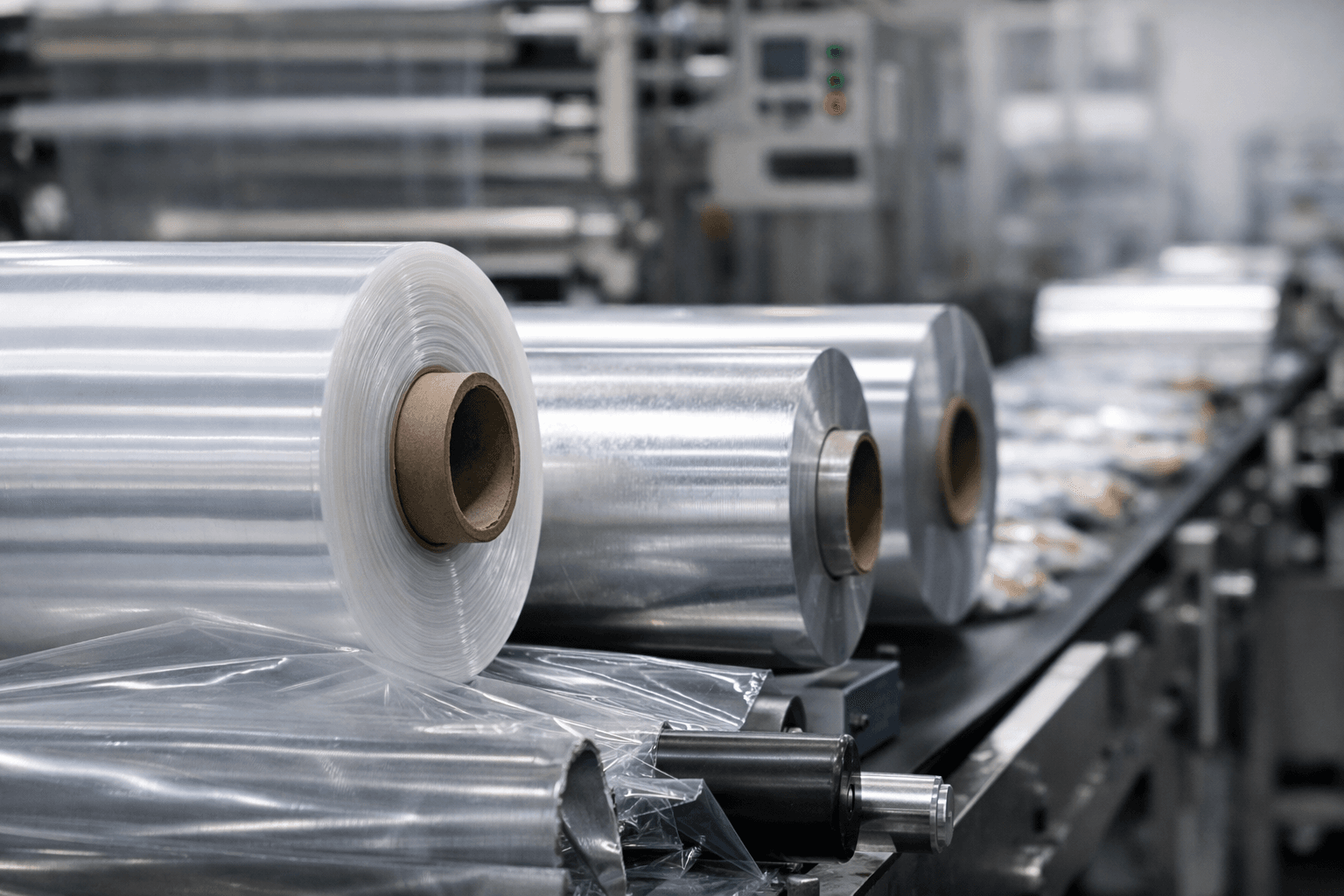
Three ways to build the barrier
The barrier comes from the structure, and each structure trades differently between protection level, transparency, recyclability and cost. The starting question is always the same: which factor degrades your product first, oxygen, moisture or light?
EVOH barrier structures
The usual way to combine transparency with a high oxygen barrier. The EVOH layer blocks oxygen, the outer layer adds mechanical strength, and the inner layer seals on the line. The choice for oxygen-sensitive products that must stay visible, and for modified atmosphere packs.
Typical structures: PP/EVOH/PP, PE/EVOH/PE.
Metallised film
A very fine metallic layer deposited on BOPP or CPP. High barrier to water vapour and strong protection from light, at a moderate cost. Opaque: the usual choice when the product does not need to be seen.
Typical for coffee, snacks and light-sensitive powders.
Mono-material barrier film
A structure that stays predominantly in one polymer family, with a thin EVOH layer for the oxygen barrier. The option for buyers who carry a recyclability requirement alongside the barrier requirement.
Typical structures: PE/EVOH/PE, PP/EVOH/PP.
The barrier level is described qualitatively on the page and documented in the technical datasheet of the structure we quote, which states the OTR (oxygen transmission rate) and WVTR (water vapour transmission rate). Those values depend on material, thickness and the measurement conditions, temperature and humidity included, so they are confirmed per structure, not promised generically. Many of these structures are built as duplex and triplex laminates, covered on their own page; the mono-material EVOH films are typically coextruded instead.
Which barrier structure fits your requirement
Three questions eliminate almost every wrong option: what barrier level does the product demand, does transparency matter, and is recyclability a requirement.
| Your requirement | Starting structure |
| Light-sensitive product that also needs opacity | Metallised film, on BOPP or CPP |
| High oxygen barrier, but the product must be visible | EVOH structure, PP/EVOH/PP or PE/EVOH/PE |
| Moisture protection at moderate cost | Metallised film on BOPP or CPP |
| Modified atmosphere packaging (MAP) | EVOH structure, specified to hold the modified atmosphere |
| Barrier and recycling-stream compatibility at once | Mono-material EVOH structure, PE/EVOH/PE or PP/EVOH/PP |
For fast-rotation products with no oxygen or moisture sensitivity, a barrier structure is money spent on protection the product never uses: a simple BOPP or PE film covers the requirement at a lower cost, and we will tell you so in the quote. Every recommendation is validated with a sample run on your machine before the series order.
Order specifications
| Parameter | What we configure |
| Barrier type | EVOH, metallised, or mono-material with barrier |
| Thickness | In microns (µm), set by the barrier structure and the mechanical load on the line |
| Width | Slit to the working width of your line, on separate rolls for separate lines |
| Barrier level | Described qualitatively and documented in the datasheet of the delivered structure |
| Printing | 1-8 colours, or unprinted |
| Line behaviour | Sealing temperature and coefficient of friction matched to the machine you specify |
| Documents | Technical datasheet per structure, migration reports with the global migration analyses carried out at IBA Bucharest, and food-contact declaration under Regulation (EU) No 10/2011, in English |
| Minimum quantity and lead time | Confirmed at quotation, for the structure, width and thickness requested |
On arrival, store rolls upright, away from direct light and heat, and remove the protective wrapping only when the roll goes on the line: improper storage can degrade the film’s performance before production even starts.
Products that justify a barrier film
A barrier structure pays for itself when the product loses quality on contact with oxygen, moisture or light: coffee, nuts, oils, cured meats, spices, protein powders, supplements and vitamins, and any pack filled under modified atmosphere. For everything else, a simple film gives all the protection the product actually needs, at a lower cost.
Coffee
Aroma lost to oxygen is revenue lost at the shelf. Metallised and EVOH structures, with optional degassing valve.
Supplements and protein powders
Hygroscopic powders clump on moisture. Oxygen and vapour barrier at once, usually in EVOH structures.
Pet food
Fat oxidation shortens shelf life in kibble. Barrier structures with puncture resistance for large formats.
Meat and MAP products
Modified atmosphere packs, where the film must hold the injected gases for the whole shelf period.
Barrier and recyclability: the trade-off
The better a structure performs as a barrier, the harder it usually is to recycle. Metallised films have limited compatibility with existing recycling streams. The direction that reconciles the two, and the way the market is moving under the PPWR, is mono-material film with EVOH barrier: a structure with a thin EVOH layer that stays predominantly within the polyethylene or polypropylene family.
Compatibility depends on the complete structure, not on the barrier type alone, and is declared on every order. VLM Poliplast does not issue a certified RecyClass class. The regulatory timeline, with Regulation (EU) 2025/40 in application since 12 August 2026, is on the PPWR guide; the all-PE and all-PP structures are on mono-material PE and mono-material PP.
Frequently asked questions
What is the difference between EVOH and metallised barrier film?
EVOH structures stay transparent and give a high oxygen barrier, so they suit packs where the product must be visible or where modified atmosphere has to be held. Metallised film is opaque, blocks light and adds water-vapour barrier at a lower cost. The choice starts from the factor that degrades your product: oxygen, moisture or light.
Can a barrier film also be recyclable?
Yes, a barrier film can be recyclable when the structure stays in one polymer family: mono-material structures with a thin EVOH layer, PE/EVOH/PE or PP/EVOH/PP, provide an oxygen barrier while remaining in the polyethylene or polypropylene family. Compatibility depends on the complete structure and is declared per order; VLM Poliplast does not issue a certified RecyClass class.
Related resources
Multilayer laminated structures
The duplex and triplex builds most barrier films are made from, layer by layer.
Mono-material PE
The all-polyethylene route to a barrier pack that stays in one recycling stream.
Mono-material PP
The all-polypropylene family, for stiffer packs at high line speeds.
Barrier pouches
The same barrier structures, converted into finished stand-up and quad seal pouches.
PPWR, Regulation (EU) 2025/40
Why barrier decisions and recyclability decisions can no longer be taken separately.
Is your current barrier film over- or under-specified?
Send the datasheet of the structure you use today, together with the product profile. We check whether the barrier level matches the target shelf life, in either direction: too little barrier costs you product, too much costs you money.
Request a quote for barrier film
No account and no catalogue to dig through. Write what the product is and what shortens its life on the shelf; the discussion starts from there.