



Environmental claims on packaging under EmpCo and PPWR
Environmental claims on packaging sold to consumers in the EU fall under two sets of rules at once. Directive (EU) 2024/825, known as EmpCo, has applied through national law since 27 September 2026. It bans certain claims in all circumstances. Article 14 of Regulation (EU) 2025/40, the PPWR, has applied since 12 August 2026. It admits a claim about a regulated packaging property only above the legal minimum. The claim must also state its scope.
Both apply to the same printed line. A claim that passes one set of rules can still fail the other. Packaging already on the shelf is not exempt.
Two instruments regulate the same claim on packaging
EmpCo amends the Unfair Commercial Practices Directive 2005/29/EC, which governs what a trader may tell a consumer. The PPWR regulates the packaging itself and, through Articles 12 and 14, what may be printed about it.
| Provision | Applies from | What it does to a claim on packaging |
|---|---|---|
| Directive 2005/29/EC, Annex I, as amended by Directive (EU) 2024/825 | 27 September 2026 | Lists practices banned in all circumstances, with no case-by-case assessment. |
| Directive 2005/29/EC, Article 6(2)(d) | 27 September 2026 | Treats claims about future environmental performance as misleading unless backed by a verified implementation plan. |
| Regulation (EU) 2025/40, Article 14 | 12 August 2026 | Admits claims about properties the PPWR regulates only above the minimum, with the scope stated. |
| Regulation (EU) 2025/40, Article 12(8) | 12 August 2026 | Prohibits labels, marks, symbols or inscriptions likely to mislead on sustainability requirements, packaging characteristics or waste management options. |
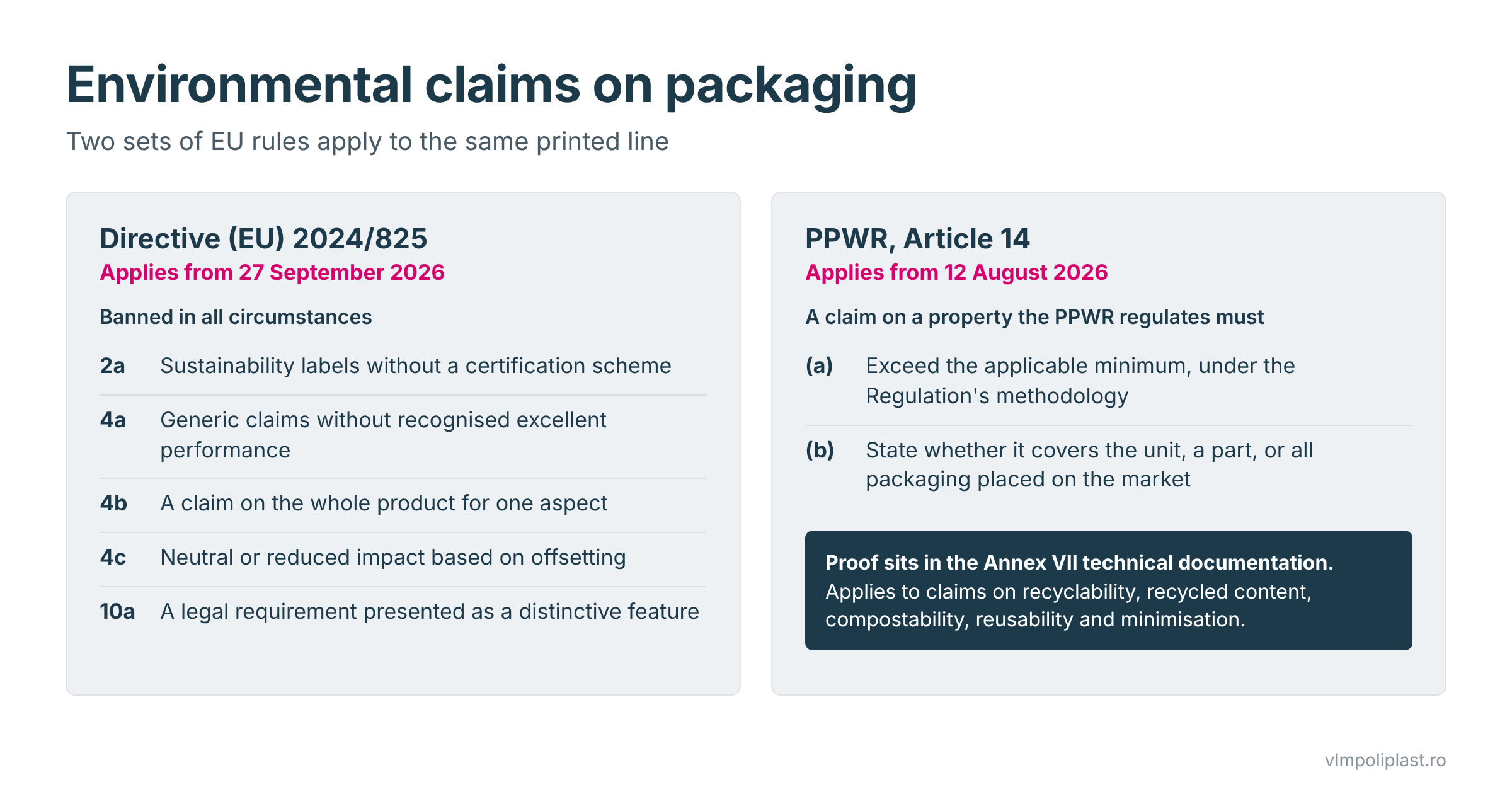
Which rule prevails and where each one stops
Recital 73 of the PPWR sets the hierarchy. Directive 2005/29/EC works as a safety net across all sectors. Where it conflicts with more specific Union rules on one aspect of unfair commercial practices, those rules prevail.
The Commission’s PPWR FAQ of August 2026, section IX, draws the line between the two. Claims about properties the PPWR regulates must comply with Article 14. The FAQ names recyclability, compostability, recycled content, reusability and weight and volume minimisation. Claims about other properties, such as recycled content in aluminium packaging, fall under Directive (EU) 2024/825 alone.
The Directive is limited to business-to-consumer practices. The Commission states this in question 1 of its Questions and Answers document on Directive (EU) 2024/825. Claims addressed to consumers, on the pack or elsewhere, are in scope. Communication between businesses is not.
What counts as an environmental claim on packaging
Article 14 of the PPWR does not write its own definition. It takes the one in Article 2, point (o), of Directive 2005/29/EC, inserted by Directive (EU) 2024/825.
“‘environmental claim’ means any message or representation which is not mandatory under Union or national law, in any form, including text, pictorial, graphic or symbolic representation, such as labels, brand names, company names or product names, in the context of a commercial communication, and which states or implies that a product, product category, brand or trader has a positive or zero impact on the environment or is less damaging to the environment than other products, product categories, brands or traders, or has improved its impact over time.”
Three consequences follow from the wording. Pictograms, colours and symbols are claims when they imply an environmental benefit. A brand name or product name can be a claim. Information required by law is not a claim. The harmonised material-composition label of PPWR Article 12(1) therefore sits outside the definition. It becomes mandatory from 12 August 2028 or 24 months after its implementing acts.
Under point (p) of the same article, a claim is “generic” when two things are true. It is not on a sustainability label. Its specification is not given in clear and prominent terms on the same medium. For packaging, the same medium is the pack.
Environmental claims banned on packaging in all circumstances
Directive (EU) 2024/825 added five points to Annex I of Directive 2005/29/EC. A practice on that list is unfair without any assessment of its effect on the consumer.
| Point | Banned practice | Packaging reference in the Directive |
|---|---|---|
| 2a | Displaying a sustainability label not based on a certification scheme or not established by public authorities. | The definition in Article 2 covers any voluntary trust mark, quality mark or equivalent, public or private. Seals and logos on the pack are included. |
| 4a | Making a generic environmental claim for which the trader cannot demonstrate recognised excellent environmental performance relevant to the claim. | Recital 9: “climate-friendly packaging” is generic; “100 % of energy used to produce this packaging comes from renewable sources” is specific. |
| 4b | Making a claim about the entire product when it concerns only a certain aspect of it. | Recital 11: a product marketed as “made with recycled material” when only the packaging is recycled. |
| 4c | Claiming, based on greenhouse gas offsetting, that a product has a neutral, reduced or positive impact in terms of greenhouse gas emissions. | Applies to the product and its packaging alike. |
| 10a | Presenting requirements imposed by law on all products in the category on the Union market as a distinctive feature of the trader’s offer. | Reaches packaging properties the PPWR already requires of every pack, discussed below. |
The generic words named in recital 9
Recital 9 gives examples of generic claims: “environmentally friendly”, “eco-friendly”, “green”, “nature’s friend”, “ecological”, “environmentally correct”, “climate friendly”, “gentle on the environment”, “carbon friendly”, “energy efficient”, “biodegradable” and “biobased”.
The words are not banned. Their generic use is. “Biodegradable” with a clear and prominent specification on the pack is not a generic claim under point (p). The same word standing alone is generic. Point 4a then bans it unless the trader can show recognised excellent environmental performance. That means the EU Ecolabel, a recognised EN ISO 14024 type I ecolabel, or top performance under other Union law.
What the PPWR requires of compostable and biodegradable packaging under Article 9 is set out on the page comparing compostable and recyclable packaging.
When “recyclable” can be printed on packaging
Recyclability is where the two instruments meet most directly. The PPWR makes it a legal requirement for every pack. Four provisions decide what a recyclability claim can say.
“All packaging placed on the market shall be recyclable.” The Commission Notice of 10 June 2026 dates it from 12 August 2026. It has no deadline of its own.
Design for recycling applies from 1 January 2030. Recycled at scale applies from 1 January 2035. Both move later if the acts are late. Grades A, B and C are set by delegated acts due by 1 January 2028.
Claims are made “only in relation to packaging properties exceeding the applicable minimum requirements”. They follow the Regulation’s criteria, methodologies and calculation rules.
It bans presenting a legal requirement for all products in the category on the Union market as a distinctive feature.
A claim that says only “recyclable” describes the minimum, not a property above it. Article 6(1) sets recyclability as the requirement for all packaging placed on the market. Article 14(a) admits claims only for properties exceeding the applicable minimum, measured with the Regulation’s own methodology. Point 10a bans presenting a requirement imposed on the whole category as a distinctive feature.
How the Commission reads Article 14 for recyclability
Its PPWR FAQ, section IX, question 1, covers claims and sustainability labels on recyclability. They must relate to properties that go beyond the PPWR minimum. They must also specify whether they refer to the whole packaging unit or a specific part of it.
Performance above the minimum is expressed in the grades of Annex II, Table 3. Those grades are assessed under the delegated acts of Article 6(4), due by 1 January 2028. Until those acts enter into force, the Commission Notice says manufacturers need not perform the conformity assessment procedure for recyclability.
Sorting labels are not claims
The harmonised label of Article 12(1) tells the consumer how to sort the pack. It is mandatory, so it is not an environmental claim. Article 12(8) prohibits other labels, marks, symbols or inscriptions likely to mislead on those waste management options.
How the grades are built is set out on the page on PPWR recyclability grades A, B and C. What an industry assessment can and cannot support is covered under RecyClass results and claims.
Recycled content claims on packaging and the parts they leave out
Recycled content is regulated by Article 7 of the PPWR, so Article 14 applies to any claim about it. Article 7(1) sets minimum shares of post-consumer recycled content for each plastic part. They are calculated as an average per manufacturing plant and year.
| Plastic packaging category | Article 7(1) | Article 7(2), 2040 |
|---|---|---|
| Contact-sensitive, PET as major component, except single-use beverage bottles | 30 % | 50 % |
| Contact-sensitive, plastics other than PET, except single-use beverage bottles | 10 % | 25 % |
| Single-use plastic beverage bottles | 30 % | 65 % |
| Other plastic packaging | 35 % | 65 % |
The Article 7(1) shares apply from 1 January 2030, or three years after the Article 7(8) implementing act if later. That act, due by 31 December 2026, sets the method for calculating and verifying the percentage.
The Commission’s PPWR FAQ, section IX, question 2, sets the benchmark for a percentage claim. The minimum targets apply, calculated as an average per manufacturing plant and per year. The claim is allowed only if the recycled content exceeds them. The claim must follow the calculation and verification methodology of the Article 7(8) implementing act.
Article 12(4) links the label to the same method. From 12 August 2028, or 24 months after the relevant implementing act, a recycled content label has fixed rules. It must follow the harmonised specifications and the Article 7(8) methodology. The Commission Notice adds that the use of such a label is voluntary.
Which part of the pack the percentage describes
Under Article 14(b), every claim states its scope. That is the packaging unit, a part of it, or all packaging the operator places on the market. Point 4b of Annex I bans a claim about the whole when it concerns only one aspect.
The Commission’s PPWR FAQ, section V, question 4, works this through for a PET bottle with a PP closure. A claim for the packaging unit is allowed above 30 % recycled content for the PET bottle or 10 % for the PP closure. Those are the Article 7(1) values for each part.
The consumer authorities of the CPC Network have already settled a coordinated action on this exact question. In commitments published by the Commission, The Coca-Cola Company dropped the line “I am a bottle made from 100% recycled plastic”. The new wording keeps the same font and font size. It reads “This bottle, excluding label and cap, is made from 100% / 50% recycled plastic”. The change is phased in as existing stock runs out, within 18 months of acceptance.
Flexible packs raise the same question with more components. A pouch can carry a reclosable zip, a degassing valve, a spout or an applied label. Those parts can be made from materials other than the laminate. A recycled content percentage on such a pack has to state which of those parts it covers.
“PFAS-free” on food-contact packaging
From 12 August 2026, Article 5(5) of the PPWR sets three PFAS limit values for food-contact packaging. Packaging at or above them cannot be placed on the Union market. The first two are 25 ppb for any PFAS and 250 ppb for the sum. Both use targeted analysis, with polymeric PFAS excluded. The third is 50 ppm for PFAS including polymeric PFAS. Compliance is demonstrated in the Annex VII technical documentation under Article 5(6).
The Regulation sets limit values. It does not define “PFAS-free”, and a statement of absence is a different statement from compliance with the limits.
Compliance with Article 5(5) is not a distinctive feature. The limits apply to all food-contact packaging placed on the Union market. Presenting that compliance as an advantage of one offer matches the practice point 10a bans. The Commission’s Questions and Answers document on Directive (EU) 2024/825 sets the condition. Point 10a applies where the requirement covers all products in the category on the EU market, imports included.
The limits, the definition of PFAS and the testing route are on the page on PFAS in food packaging.
Claims about future environmental performance
A target printed on a pack is a claim about future performance. Article 6(2)(d) of Directive 2005/29/EC treats it as misleading unless it rests on clear, objective, publicly available and verifiable commitments.
They must sit in a detailed and realistic implementation plan, with measurable, time-bound targets and allocated resources. An independent third-party expert must verify the plan regularly, and the findings must be made available to consumers.
Packaging already printed before the rules applied
The Commission’s Questions and Answers document is direct on old stock. From 27 September 2026, environmental claims and sustainability labels must comply. That includes products or packaging already manufactured, ordered, distributed or on retailers’ shelves before that date.
| Source | What it says about packaging already produced |
|---|---|
| Commission Q&A on Directive (EU) 2024/825, Q18 | No exemption for old stock. Claims may be covered or corrected with stickers, or supplemented with information at the point of sale. |
| CPC Network common understanding, June 2026 | Traders must act without delay. Authorities may phase enforcement where there are genuine transitional difficulties, such as packaging cycles and stock volumes. They may refrain from requiring recall or destruction. The document states it is not legally binding. |
| PPWR Article 12(12) | Packaging made or imported before a labelling deadline of Article 12(1), (2) or (4) may still be made available. The limit is 3 years from the entry into force of that requirement. |
| Commission Notice, section 5 | No transitional period for PFAS stocks. Food-contact packaging placed on the market before 12 August 2026 may remain on the market. |
Among the corrective measures it lists, the CPC common understanding names “adapting future packaging and new orders”. For a printed flexible pack, that means the artwork of the next production run.
Who makes the claim and who holds the evidence
Under the Directive, the claim belongs to the trader who makes it to the consumer. Point 4a turns on whether “the trader is not able to demonstrate” the performance claimed.
Under the PPWR, compliance with Article 14 is demonstrated in the Annex VII technical documentation. The manufacturer draws it up before placing packaging on the market, under Article 15(2). Article 16 obliges suppliers of packaging or packaging materials to give the manufacturer what it needs. That covers the information and documentation to demonstrate conformity with Articles 5 to 11.
The manufacturer role for a branded pack is set out on the page on PPWR compliance and the manufacturer.
Green Claims Directive and Digital Fairness Act: where they stand
Green Claims Directive. Proposal COM(2023) 166 was never adopted and creates no obligation. Parliament adopted its first-reading position on 12 March 2024. The Legislative Observatory records the procedure as awaiting the Council’s first-reading position. On 4 November 2026 the Commission listed the proposal under withdrawals in Annex III of its 2027 work programme.
Digital Fairness Act. On 11 November 2026 the Commission proposed a regulation, COM(2026) 1100. It would repeal Directive 2005/29/EC from its date of application. Its Annex I carries the environmental points over without change of substance, under new numbers.
| Practice | Directive 2005/29/EC | DFA proposal |
|---|---|---|
| Uncertified sustainability label | Point 2a | Point 3 |
| Generic environmental claim | Point 4a | Point 6 |
| Whole product for one aspect | Point 4b | Point 7 |
| Offset-based neutrality | Point 4c | Point 8 |
| Legal requirement as distinctive feature | Point 10a | Point 18 |
The DFA is a proposal before Parliament and Council. Until it applies, environmental claims on packaging remain governed by Directive 2005/29/EC as amended by Directive (EU) 2024/825. The PPWR applies alongside it.
Sources
Regulation (EU) 2025/40, as published in the Official Journal L of 22 January 2025: recital 73, Articles 5(5) and 5(6), 6(1) to 6(4), 7(1), 7(2) and 7(8), 12(1), 12(4), 12(8) and 12(12), 14, 15(2), 16 and 71, Annex II and Annex VII. The Commission Notice in the Official Journal C, 2026/3084 of 10 June 2026, sections 5, 6 and 13. The Commission’s FAQ on the Packaging and Packaging Waste Regulation, updated August 2026, section V question 4, section VIII question 2 and section IX questions 1 to 3.
Directive (EU) 2024/825: Articles 1 and 4, recitals 9 and 11, and the definitions and points it inserts into Directive 2005/29/EC. The Commission’s Questions and Answers document on Directive (EU) 2024/825 of September 2026, questions 1, 16 and 18.
The CPC Network common understanding on old stock situations of June 2026. The commitments of The Coca-Cola Company to the CPC Network, published by the Commission.
For the Green Claims Directive: the Legislative Observatory file 2023/0085(COD) and the annexes to the Commission work programme 2027, COM(2026) 710. For the Digital Fairness Act: the annexes to proposal COM(2026) 1100.
Every statement on this page was checked against these official texts. No secondary source was used.
Related resources
Grades A, B and C in Annex II, Table 3, and the dates from which they decide market access.
→ See the grades
The Article 7 shares for 2030 and 2040, what counts as post-consumer, and the exemptions.
→ See the targets
The three Article 5(5) limits, the structural definition of PFAS and the testing route.
→ See the limits
Article 39 and Annex VIII: who signs it, what it contains and the Annex VII file behind it.
→ See the structure
Article 9 of the PPWR and what “biodegradable” and “compostable” can and cannot claim.
→ Compare the two
The full framework, obligations per operator and dates from 2026 to 2040.
→ Read the guide
Changing a claim means changing the artwork of the next print run. Our technical team can tell you what the documentation for each structure we supply covers.
Reviewed by Laura Ionescu, VLM Poliplast SRL, on 14.11.2026, against the official texts listed under Sources. VLM Poliplast SRL holds editorial responsibility for the content of this page. This page is not legal advice.